- >
- Blog >
- How to Register a Car in Cyprus (2026 Step-by-Step Guide)
How to Register a Car in Cyprus (2026 Step-by-Step Guide)


40,778
Passenger cars registered
in Cyprus in 2025 (CYSTAT)
64.1%
Were second-hand
vehicles changing hands
€8.54
Official transfer fee
at the KEP / RTD counter
30 days
Notification deadline
to register after a private sale
Cyprus registered 40,778 passenger cars in 2025, of which 64.1% were used vehicles changing ownership. That's roughly 26,000 transfers between private buyers and sellers in a single year, mostly new-arrival expats and Cypriot residents picking up second-hand cars from classifieds and small lots.
The process trips up almost everyone the first time. Forms are in Greek, insurance is handled in a separate office, the February 2025 Recall Exemption Certificate rule isn't in older guides, and three different paths (used, brand-new, imported) get conflated everywhere online.
This guide separates them, with the form to file, what to bring, what it costs in 2026, and the right order to do everything. Last updated 1 May 2026.
How do you register a car you just bought in Cyprus?
That's the standard private resale path, covering about two thirds of all Cyprus registrations. Brand-new cars from a Cyprus dealer use Form TOM 6 instead, and the dealer normally files everything. Imports (EU or post-Brexit UK) also start with Form TOM 6, plus customs paperwork before the RTD will issue plates.
Used car, new car, or import: which process applies to you?
The starting paperwork depends entirely on where the car is coming from. A second-hand car already on Cypriot plates is the simplest case. A brand-new dealer car is normally handled for you. An import is by far the most paperwork. Of the 40,778 passenger cars registered in 2025, 64.1% were used and 35.9% were new (Cyprus dealer stock plus private imports).
| Step | Used car (already in Cyprus) | Brand-new (Cyprus dealer) | Imported (EU or UK) |
|---|---|---|---|
| Form to file | TOM 9B (Transfer of Ownership) | TOM 6 (First Registration) | TOM 6 + customs declaration |
| Where to go | Any KEP or RTD office | Dealer files; you collect plates | Customs first, then RTD |
| Who handles it | You and the seller | Dealer | You (or a customs broker) |
| Key documents | Logbook, MOT, Recall cert, cover note, IDs | Invoice, Certificate of Conformity, your cover note | V5C, MRN, Certificate of Conformity, customs receipts, cover note |
| Typical timeline | Same day at counter; logbook by post in 2-3 weeks | 3-5 working days | 2-6 weeks total |
| Typical first-year cost | €235 to €1,800 (transfer + tax + insurance) | Bundled into on-the-road price | Several thousand euros once duty, VAT, and registration tax stack |
First runaround off Bazaraki? Column one. Walking into a Toyota or Hyundai showroom? Column two. Shipping a car from London or Berlin? Column three. The rest of this guide covers all three, but most of it deals with the used-car path, since that's the one most readers actually file themselves.
Documents checklist: what to bring to the KEP counter
For a TOM 9B transfer, bring all eight of these to the counter on the day:
- 1Original logbook (kotsáni, the small green-and-white booklet Cypriots refer to by its Greek name)
- 2Form TOM 9B signed by buyer and seller in capital letters
- 3Valid MOT certificate (called the roadworthiness test in Cyprus)
- 4Recall Exemption Certificate, or proof the car is exempt from open recalls
- 5ID card or passport for both parties
- 6Cover note in the buyer's name with expiry more than three months from the date of transfer
- 7Proof that road tax has been paid with no arrears
- 8€8.54 in cash or by card
A few of these catch people out. The kotsáni is non-negotiable; if the seller has lost it, they need to file for a replacement at the RTD before the transfer, which can take a couple of weeks (confirm the current administrative fee at your KEP). Don't pay for the car until it's sorted, because without the logbook the transfer can't happen.
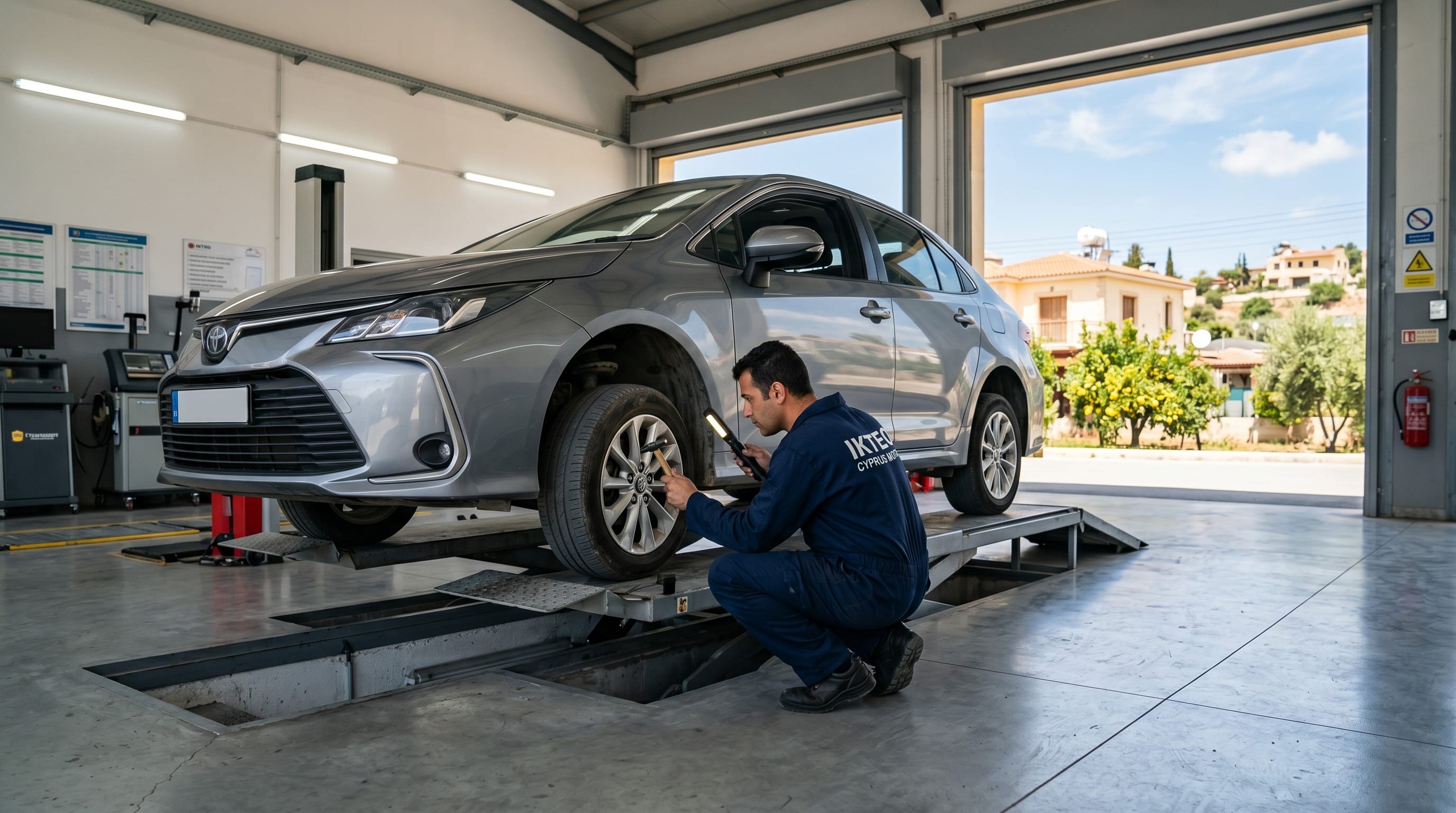
The MOT must be in date on the day of transfer. If it expired last week, book a slot at any IKTEO (private testing centre) or KEMO (state-run testing centre) before your KEP visit. Expect a fine of €150 if you drive on an expired MOT.
Proof of paid road tax can be a recent receipt, an online printout from the RTD renewal portal, or the windscreen sticker. The clerk checks the system anyway, and any arrears pause the transfer until the seller clears them.
How much does it cost to register a car in Cyprus in 2026?
A. Used car transfer (Form TOM 9B)
| Item | Cost |
|---|---|
| Transfer fee | €8.54 |
| Mukhtar / certifying-officer fee | €5 to €10 (waived if both parties present) |
| MOT | €35 to €40 |
| Recall Exemption Certificate | Free |
| Road tax | €10 to €1,500 a year (CO2-based) |
| MTPL insurance | From €180 a year |
B. First registration (Form TOM 6 — new dealer car or import)
| Item | Cost / Notes |
|---|---|
| Registration excise tax | One-time tax based on CO2 emissions and engine size; assessed by Customs at first registration. Budget several hundred to several thousand euros. |
| VAT 19% | EU imports: only on a 'new means of transport' (≤6 months old or under 6,000 km). UK imports: applies regardless of age or mileage. |
| Customs duty | Around 10% on non-EU/UK imports (post-Brexit) |
| First roadworthiness inspection (TEL 72A) | Around €40 |
| Annual road tax | €0.50/g at 0-120 g/km; €3/g at 121-150 g/km; €6/g at 151-180 g/km; €12/g above 180 g/km; capped at €1,500/year. Zero-emission EVs: €0/year. |
| MTPL insurance | From €180 a year |
For more on the road-tax bands, see our guide to Cyprus road tax in 2026. For the testing process and what's checked, see our guide to the Cyprus MOT (roadworthiness test).
You must have car insurance before the transfer (here's how to get it fast)
The cover-note workflow is straightforward. Call DigiCare or use the online quote form, send the registration number (or VIN if you haven't bought yet), and the cover note arrives by email in minutes. That's what the clerk wants to see. The three-month validity rule comes from the official Greek-language TOM 9Γ form, which counter staff use to check insurance before releasing the new logbook.
A broker can pre-issue a cover note tied to the car's registration so you arrive at the KEP ready. The alternative? Walking up to a random insurer and asking for same-day cover on a car you don't own yet, which often takes longer than the transfer itself. Our cover note insurance Cyprus guide explains exactly how cover notes work in Cyprus, and our roundup of the best car insurance companies in Cyprus covers the main insurers a broker can place you with.
Buying a car this week? Send us the registration number and we'll send a TOM 9B-ready cover note in minutes.
Get your cover note in 2 minutesStep-by-step: how to transfer ownership at the KEP or RTD office
Here's the full sequence, from agreeing the price to driving away with a stamped TOM 9B. Allow about a week from start to finish if everything is clean. The counter visit takes 20 to 40 minutes, but the prep around it (insurance, recall check, MOT if expired) is what trips most buyers up.
Agree the price and inspect the logbook.
Check the kotsáni in the seller's name, confirm the chassis number on the booklet matches the one stamped on the car, and check road tax is paid up to date.
Buy your insurance and get a cover note in your name.
Send the registration number to your broker. Ask for at least three months' validity from the planned transfer date.
Confirm or apply for a Recall Exemption Certificate.
The seller obtains this; it's free; it must be in hand before you arrive at the counter.
Both parties complete Form TOM 9B in capital letters.
Use blue or black ink. Sign in the boxes marked for buyer and seller. Errors mean the form is rejected.
Visit any KEP or RTD office.
Offices are open in Nicosia, Limassol, Larnaca, Paphos, and the Famagusta district. No appointment is needed at most KEPs; you take a ticket and wait.
Pay €8.54 and surrender the old logbook.
Cash or card. The clerk stamps the TOM 9B and gives you a copy.
Receive your stamped TOM 9B.
The new logbook arrives by post in 2 to 3 weeks. Keep the stamped TOM 9B in the car until then; it's your proof of legal ownership.
What if only one party can attend? The Mukhtar rule
Every village and town district in Cyprus has a Mukhtar, a certifying officer who can witness and stamp signatures. If only the buyer or seller can attend the KEP, the absent party signs their half of the TOM 9B in front of a Mukhtar in advance. The Mukhtar's stamp is accepted at the counter as a substitute for in-person attendance.
The fee is usually €5 to €10. Find your nearest Mukhtar through the local community council office, or ask the seller's neighbours. In smaller villages it's the person everyone goes to for property and ID matters. The Mukhtar's official seal is what makes the signature valid, so a regular notary stamp won't do.
What is a Recall Exemption Certificate, and why it matters (Feb 2025 rule)
The rule traces back to the Takata airbag scandal. More than 80,000 cars in Cyprus were flagged for the recall before the certificate system went live. Faulty Takata inflators have been linked to fatal accidents worldwide, and the RTD wanted to stop affected cars from quietly changing hands.
Check whether a specific car is affected at gov.cy/mtcw/airbag-recalls/, or call the dedicated hotline on 22 600500. If the car is on the list, the seller has to fix the recall (free, at the manufacturer) and obtain the exemption afterwards. If it's clear, the certificate is issued in a few minutes. The current TOM 372 declaration framework, in force since June 2025, covers the different scenarios (open recall, completed recall, exempt vehicle).
The 30-day rule: what happens if you miss the deadline
We see this every few weeks at the agency office: the buyer drives for two months on the seller's logbook, then road-tax renewal notices and traffic fines start landing at the seller's old address. Until the TOM 9B is filed, the system still thinks the seller owns the car, so speed-camera tickets and road-tax bills stay on their record. The fix for late filings is simple. Visit the RTD with both parties (or with a Mukhtar-certified TOM 9B), pay the €8.54, and clear any fines from the gap. There's no fixed late-filing penalty beyond the standard offence fine, but the longer you leave it, the messier it gets.
Buying a brand-new car from a Cyprus dealer (first registration)
If you're buying new from a franchised dealer, registration is normally bundled into the on-the-road price. The dealer files Form TOM 6 (Application for First Registration), arranges the first roadworthiness inspection (Form TEL 72A), pays the CO2-based registration tax, charges VAT 19% on the invoice, and registers the car directly in your name.
What the dealer does NOT provide is your insurance. You're still responsible for arranging a Motor Third-Party Liability cover note in your name before the dealer can complete the registration. This catches some first-time buyers off guard: you sign for the car, then you're told the plates can't be issued until you produce a cover note. Call your broker a few days before delivery with the chassis number, get the cover note emailed over, and forward it to the dealer.
The on-the-road quote should itemise the invoice price, VAT 19%, CO2 registration tax (per the Customs and Excise schedule), and first-year road tax. Ask for the breakdown if the dealer only quotes a single number. It makes comparing rival showrooms much easier.
Importing a car from the UK or EU: the extra steps
Importing is a customs job before it's a registration job. The car has to clear Cyprus Customs and Excise first, then go through first registration at the RTD (Form TOM 6) and a roadworthiness inspection (Form TEL 72A). Two paths apply, depending on origin.
EU imports
The Single Administrative Document (T2L or T2LF, now replaced by a Movement Reference Number, the MRN) confirms EU-origin status, so no customs duty inside the EU. You'll still need the manufacturer's Certificate of Conformity. VAT 19% applies only if the car qualifies as a 'new means of transport' under Cyprus Customs and Excise rules, meaning under six months old or fewer than 6,000 km on the clock. Beyond either threshold, no VAT. CO2-based registration tax applies regardless.
UK imports (post-Brexit)
Since 1 January 2021, UK cars are treated as non-EU imports. Expect customs duty of around 10% on the customs value, plus VAT 19% on customs value plus duty, plus CO2 registration tax. The CN22 or CN23 customs declaration is mandatory. The 6-month / 6,000 km 'new means of transport' exemption is an intra-EU rule and does not apply here, so VAT 19% lands on every UK import, regardless of age or mileage. That's the single biggest cost difference between an EU import and a UK one.
How to deregister your UK car before importing to Cyprus
Notify the DVLA before shipping. Fill in the permanent export section (V5C/4) of your UK logbook and send that tear-off slip to the DVLA. Keep the rest of the V5C with you, because Cyprus Customs and the RTD need the original document to register the car here.
The V5C is what Cyprus Customs uses to verify the customs value, which the 10% duty and the 19% VAT are calculated on. Without it, Customs may default to a higher valuation drawn from auction or trade-pricing tables, which can mean hundreds of euros in extra duty on a mid-range hatchback. Deregister first, ship second, and never post the main V5C to the DVLA.
For the full sequence (customs Form C72A, TOR exemption, the SVA inspection, the 10-day registration window, and the Cyprus motor insurance you need before plates), see our dedicated guide to importing a car to Cyprus.
Why transfers get rejected at the KEP: the 6 most common reasons
Six issues come up again and again at the agency office. Each has a quick fix, but each one also means another trip back to the counter if you don't catch it before you go. If you haven't sorted your car insurance yet, that's the one to fix first.
Expired MOT.
Fix: book an IKTEO or KEMO test before your KEP visit and bring the new certificate.
Unpaid road tax arrears.
Fix: clear all outstanding amounts on rtd.mcw.gov.cy before the transfer.
Missing Recall Exemption Certificate.
Fix: ask the seller to apply via gov.cy/mtcw/airbag-recalls/ or call 22 600500.
Missing seller signature or wrong placement on TOM 9B.
Fix: re-print Form TOM 9B and have both parties sign in capital letters in the correct boxes.
No cover note in buyer's name (or expiry under three months).
Fix: contact your broker for a fresh cover note before visiting the KEP.
Identity or passport details don't match the logbook.
Fix: bring both old and new ID if your name has changed; passport spellings must match logbook spellings exactly.
Can you register a car in Cyprus on just a passport?
Plenty of digital nomads, students, and freshly-arrived employees handle this in their first weeks. Some KEPs ask for proof of address (a signed rental contract or utility bill works), but the passport is the primary ID. If you're working through this for the first time, our expat car insurance guide covers the cover-note side. Most insurers will issue a policy on a passport with no residence permit, as long as you have a valid driving licence and a Cyprus address for documents.
How to check your registration status and track your new logbook
After the transfer, the new logbook is printed and posted, which takes 2 to 3 weeks. To check progress, use the RTD renewal portal. Type in the plate, and the portal returns the registered owner, road-tax status, and MOT expiry. Once your name appears as registered owner, the transfer has cleared, even if the physical logbook hasn't yet landed in your post box.
If it hasn't arrived after four weeks, call the RTD on 22 807000 with your stamped TOM 9B reference and ask them to check the print queue. Lost-in-post cases are uncommon, but they happen. The RTD will reissue at no charge if the postal address on file matches the one you gave at the counter.
The same portal handles annual road-tax renewal, which you'll do online from year two onwards. Bookmark it. It's the single most useful gov.cy address for car owners in Cyprus.
Want a fuller explainer on the plates themselves? Read our Cyprus number plates regulations 2026 guide for colour codes, replacement fees, and the 2036 letter exhaustion.
Frequently Asked Questions
Buying a car in Cyprus is mostly a paperwork problem
Buying a car in Cyprus is mostly a paperwork problem, and the paperwork problem starts with insurance. Get the cover note in your name first, get the Recall Exemption Certificate from the seller, fill out the TOM 9B in capital letters, and the €8.54 visit to the KEP is the easy part. Miss any of those and you'll be back at the counter for a second trip.
DigiCare's role is the cover-note step. Send us the registration number, and a TOM 9B-ready cover note with the right validity window lands in your inbox in minutes. We can also pre-issue against a VIN if you haven't completed the purchase yet, so you can pay the seller and walk straight to the KEP the same afternoon.
Buying a car this week? Get your TOM 9B-ready cover note in 2 minutes.
Get a free car insurance quoteBuying or transferring a car in Cyprus? Get a TOM 9B-ready cover note in 2 minutes.
Get a Free Quote