
- >
- Blog >
- What Happens If You Drive Without Insurance in Cyprus? Penalties, MIF, and Real Numbers (2026)
What Happens If You Drive Without Insurance in Cyprus? Penalties, MIF, and Real Numbers (2026)

€200
Fixed-penalty notice
Issued on the spot since 1 Oct 2020
€6,000
Max court fine
For a repeated conviction
12 months
Max licence suspension
On repeat conviction
€500
MIF threshold
Property damage in untraced cases
Driving uninsured in Cyprus is one of the fastest ways to turn an otherwise quiet week into a court date, a tow bill, and a renewal premium that climbs for years. A single roadside check can cost a driver several thousand euros, their licence, and a criminal record, and the rules apply equally to short-term residents and long-term Cypriots.
This guide from DigiCare Insurance sets out what the law says, what actually happens at the roadside, and how the Cyprus car insurance market handles the fallout. The penalty framework below has been in force since 1 October 2020 and is still fully active in 2026. The only thing that has shifted since then is premium inflation, which quietly lifts the long-tail cost of a conviction year on year.
If you only want to confirm one thing first, our short answer on whether is car insurance mandatory in Cyprus covers the basics in 60 seconds. The short version: driving without third-party insurance in Cyprus is a criminal offence punishable by a €200 fixed penalty, vehicle impoundment, and court fines up to €6,000 for repeat offenders.
Is It Illegal to Drive Without Insurance in Cyprus?
Third-party liability is the legal floor in Cyprus. It is the minimum cover the statute requires, and it pays for injury or property damage you cause to other people. Anything beyond that (your own car, theft, fire) is optional and sold as comprehensive cover.
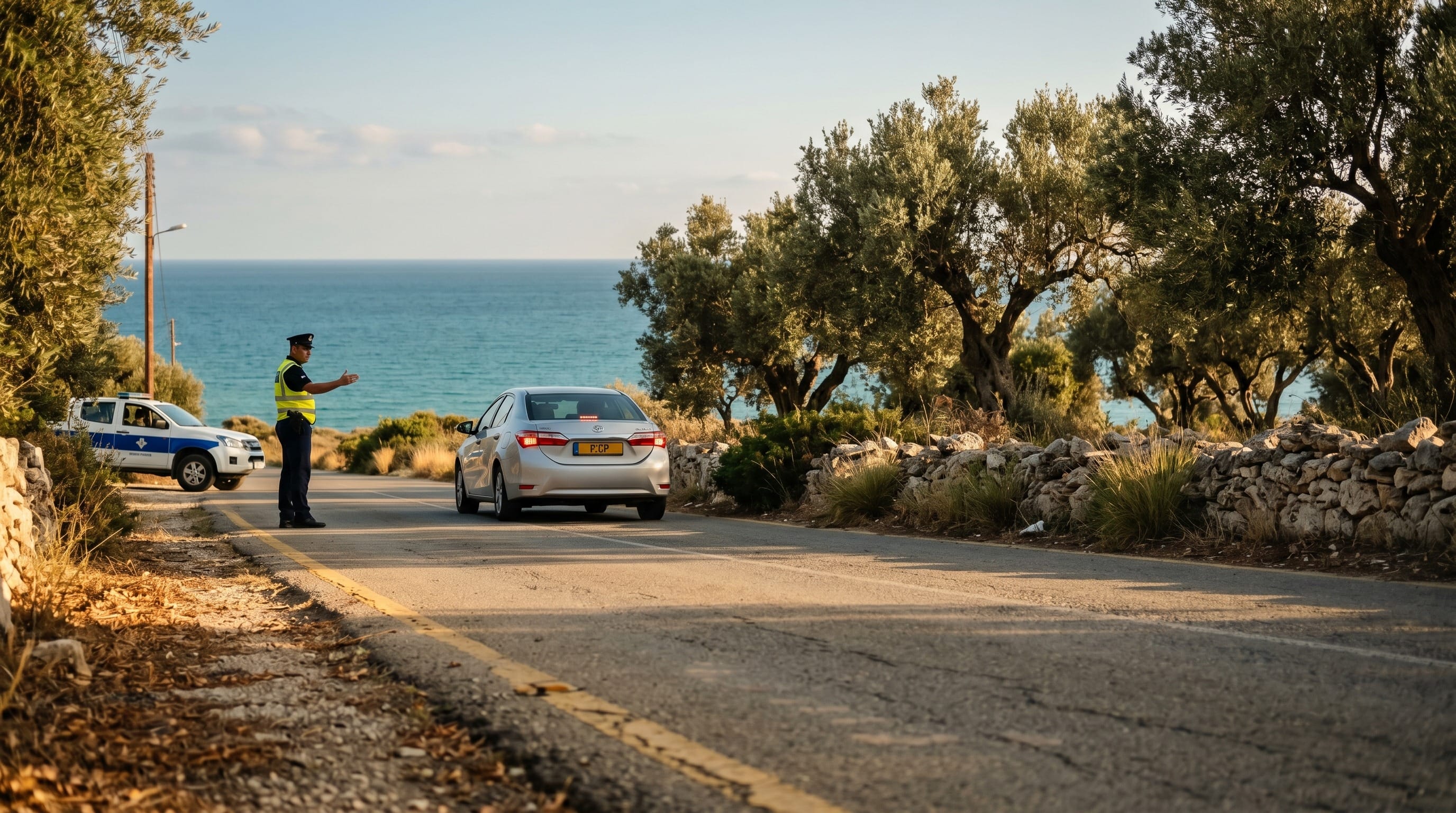
Cyprus Police verify insurance status at the roadside in real time. Every motor policy issued by a licensed Cyprus insurer is registered in the Motor Insurers' Fund central database, and an officer can confirm cover by registration plate during any stop. "No record found" on the officer's screen is enough to begin the offence procedure, even if you genuinely believe you have a policy somewhere. For a longer explanation of the legal duty to insure, see our FAQ on whether is car insurance mandatory in Cyprus.
The Law Behind the Penalty: Cyprus Law 96(I)/2000 and the EU Layer
Cyprus motor insurance rules sit on top of an EU framework. The chain runs from a European directive down to a Cyprus statute, then to a regulator, and finally to a fund that pays victims when the system fails.
The EU Motor Insurance Directive 2009/103/EC obliges every member state to require compulsory motor third-party liability cover. Cyprus implements this through the Motor Vehicles (Third-Party Insurance) Law of 2000, which sets the minimum cover any vehicle on a public road must carry: €38.6 million for bodily injury per accident and €1.3 million for property damage. These figures are not optional. They are the statutory floor every Cyprus motor policy meets or exceeds.
The Insurance Companies Control Service (ICCS), Cyprus's insurance regulator under the Ministry of Finance, licences insurers and enforces compliance. When a driver hits the road without cover, the safety net is the Motor Insurers' Fund of Cyprus (MIF), established in 1969 and funded by a 5% levy on every motor insurance premium written in the country.
Cyprus motor insurance legal cascade
| Layer | Instrument | What it requires |
|---|---|---|
| European Union | EU Motor Insurance Directive 2009/103/EC | Member states must require compulsory motor third-party liability cover |
| Cyprus statute | Motor Vehicles (Third-Party Insurance) Law of 2000 (Law 96(I)/2000) | Every vehicle on a public road must carry at least third-party liability cover |
| Regulator | Insurance Companies Control Service (ICCS) | Licences insurers; enforces compulsory-insurance compliance |
| Statutory fund | Motor Insurers' Fund of Cyprus (MIF) | Pays compensation to victims of uninsured or untraced drivers |
Penalties at a Glance: What You Could Pay for Driving Uninsured
Cyprus uninsured driving penalty comparison
| Consequence | First offence | Repeated offence | Source |
|---|---|---|---|
| Fixed-penalty notice | €200 (on-the-spot) | €200 (impoundment likelier) | Motor Insurers' Fund of Cyprus, 2020 |
| Court fine on conviction | Up to €3,000 | Up to €6,000 | Cross-referenced industry sources |
| Imprisonment (court) | Up to 1 year | Up to 2 years | Cross-referenced industry sources |
| Licence suspension | At least 6 months | At least 12 months | Cross-referenced industry sources |
| Penalty points | 3 to 6 points | Cumulative toward 12-point ban | Cyprus penalty-point framework |
| Vehicle impoundment | Yes (until cover produced) | Yes (longer hold likely) | Motor Insurers' Fund of Cyprus, 2020 |
Court fines and imprisonment terms are statutory maximums under Law 96(I)/2000; actual sentences are at the court's discretion and may be lower. Cross-reference with the current statute before relying on these figures for legal advice.
The €200 fixed-penalty notice has been in effect since 1 October 2020, when Cyprus Police and the MIF adopted the new penalty schedule. The penalty-points side runs under the Cyprus 12-point disqualification framework: convictions stack inside a 3-year window, and reaching 12 points triggers an automatic ban.
Reconciling the Numbers: Why You'll See €200, €2,000 and €3,000 Quoted for the Same Offence
The fixed-penalty notice
This is an out-of-court fine administered through the MIF and Cyprus Police. Pay it, accept the points, and the matter closes without a court hearing. The penalty is €200 flat, whether it is your first offence or your tenth.
The summary conviction in district court
When prosecutors push the case to court (after a repeat offence, an accident with injury, or a refusal to pay), penalties scale to the Cyprus statute. A first conviction can reach €3,000. A repeat conviction can reach €6,000, with imprisonment of up to 1 to 2 years on the upper bound.
The €2,000 figure
Older Cyprus sources and our previous guidance on cover notes cite €2,000 in a slightly different statutory context, namely a lapsed temporary cover. That guide explains the timing trap: a lapsed cover note is treated as no insurance, and the maximum fine cited under that scenario predates the current €3,000/€6,000 court figures used for general uninsured driving prosecutions.
How to Get Your Impounded Car Back in Cyprus (and Why It Happens)
Cyprus police can impound under Law 96(I)/2000 the moment a vehicle is found uninsured. There is no warning step. The car is towed from the roadside to a designated holding compound, and you walk away with a written notice and a list of documents to produce.
The release process step by step
Cyprus Police seize the vehicle.
The car is towed from the roadside to a designated holding compound.
You receive a written notice.
It lists the impound location and the documents required to release the car.
Produce valid documentation.
Bring a current Insurance Certificate, the Vehicle Registration Certificate (Title of Ownership), a valid driving licence, and proof of road tax and MOT to the issuing police station.
Pay outstanding charges.
Settle the fixed-penalty notice and the storage fees (rates set locally; confirm with the issuing station).
Collect the vehicle.
You receive a release form. If the MOT or road tax has also lapsed, those must be cured before the vehicle is released.
You can verify the registration and licence position online using the Cyprus government vehicle and licence lookup. One thing worth flagging: even an insured owner can have the car impounded if it was driven uninsured by someone else. For the surrounding paperwork, see our guides on Cyprus road tax and MOT in Cyprus.
Get a Cyprus motor insurance certificate online in under 60 minutes.
Get a Free QuoteHit by an Uninsured or Untraced Driver: The Motor Insurers' Fund (MIF) Claim Path
The MIF claim procedure
Notify Cyprus Police immediately.
Within 48 hours for hit-and-run cases.
Notify the MIF.
Contact the Motor Insurers' Fund of Cyprus and request a claim file.
Attend the MIF damage inspection.
This must happen before any repairs are started.
Submit the claim form.
Include the Vehicle Registration Certificate (Title of Ownership) and Insurance Certificate.
Attach medical evidence.
Medical certificates and reports are required for any bodily-injury claim.
Foreign-plate accidents.
For accidents involving foreign-plated vehicles, contact the Cyprus International Insurance Bureau (CIIB).
The €500 property-damage threshold applies only to untraced (hit-and-run) cases. If the at-fault driver is identified but uninsured, you can claim for property damage of any value, and bodily-injury claims have no minimum threshold in either scenario. For a clear walk-through of the claim file and supporting documents, see this Cyprus accident-claim legal guidance.
If you have just been in a crash, our step-by-step guide on what to do after a car accident in Cyprus walks you through the scene, the police report, and the claim.
Hidden Costs: Criminal Record, Penalty Points, and Why You May End Up in the Rejected Risks Pool
The fine is the visible cost. The consequences that follow are the ones that quietly compound over time.
Criminal record
A conviction for driving uninsured is a criminal offence on the Cyprus court register. It appears on background checks used for employment screening, professional licensing, and certain visa applications.
Penalty points and the 12-point disqualification
Each conviction adds 3 to 6 points to your licence. Under the Cyprus 12-point disqualification rule, reaching 12 points within a 3-year window triggers automatic disqualification. Points clear 3 years after the offence date, so a second offence inside that window can be enough on its own to trigger the ban.
Future premiums
Insurers price risk on conviction history. Cyprus motor premiums rose 9.4% in the first half of 2025 (Insurance Association of Cyprus, 2025), so a post-conviction driver is shopping in a market that is already inflated. Expect significant loading on your renewal premium once a conviction is on file. Some insurers may decline cover entirely, routing you to the Cyprus Hire and Rejected Risks Pool, where premiums sit well above market rates. Young drivers carry the heaviest loadings, which is why we cover them separately in our guide to car insurance for young drivers in Cyprus.
The Cyprus Hire and Rejected Risks Pool
When three insurers refuse cover, the MIF routes the driver to the Cyprus Hire and Rejected Risks Pool, operated via cypool.net. The four-step access flow: the driver collects three written rejections, submits them to the MIF, the MIF requests a 48-hour insurer response, and the driver is then referred to the Pool. Premiums in the Pool sit well above market rates.
Summary of hidden costs
- A criminal record that surfaces on background checks for years.
- Penalty points that stack inside a 3-year window toward a 12-point ban.
- Future premiums loaded significantly on renewal.
- Risk of being routed to the Cyprus Hire and Rejected Risks Pool at well above market rates.
What If You Let Someone Else Drive Your Car Uninsured?
Cyprus underwriters split policies into two structures. A named-driver policy lists each authorised driver by name, age, and licence history; anyone else who drives the car is, in law, uninsured. An open-driving policy covers any licensed driver who meets the age and experience criteria written into the schedule. Our comparison of named-driver vs. open-driving policies walks through how each insurer phrases the clause.
A widely cited PathLegal case study describes the exact scenario our agents see most often: the owner held a valid policy, the friend who borrowed the car was not named, and the friend was prosecuted independently for driving uninsured. The owner was not charged with the same offence in that case, but the car was impounded for the duration.
Crossing into North Cyprus voids your motor insurance
Republic-of-Cyprus motor policies do not extend across the Green Line. Separate cover must be purchased at the crossing point, typically around €25 per month for a passenger car. Drivers crossing without buying the separate cover are uninsured the moment their wheels cross. The same rule applies in reverse for North Cyprus vehicles entering the Republic.
For families where a son or daughter under 25 occasionally drives a parent's car, the safest route is to add the young driver as a named driver before they take the wheel. Our guide on car insurance for young drivers in Cyprus explains the typical surcharges.
How to Get Legally Insured in Cyprus in Under 24 Hours
Closing the gap takes less time than most drivers expect. A digital broker can issue a certificate the same day, and Cyprus Police will accept emailed proof at the issuing station if your car has been impounded.
Three steps to get back on the road legally
Get a quote in five minutes.
Use the DigiCare instant quote form at /get-instant-car-insurance-free-quote.
Sign the policy digitally.
Pay online with card or bank transfer; the policy is bound on confirmation.
Present your Insurance Certificate.
Email it to the Road Transport Department (RTD), or present it at the issuing police station to clear an impoundment.
Every Cyprus-market motor policy, including the cheapest third-party-only option, meets or exceeds the statutory minima set out in Law 96(I)/2000: €38.6 million for bodily injury and €1.3 million for property damage per accident. Comprehensive cover adds your own vehicle, theft, fire, glass, and usually uninsured-driver protection on top.
For an end-to-end overview of the market, see our complete Cyprus car insurance guide. If you are a non-Cypriot resident, our Cyprus car insurance for expats guide covers licence transfer and documentation.
Frequently Asked Questions
Conclusion
Driving uninsured in Cyprus exposes you to a €200 on-the-spot fine, court penalties of up to €6,000, vehicle impoundment, a criminal record, and 3 to 6 licence points that count toward an automatic ban. If you are on the receiving end, the Motor Insurers' Fund of Cyprus pays compensation for injury and, above €500 in hit-and-run cases, property damage.
DigiCare issues a Cyprus-compliant motor policy in minutes online. The cheapest legal third-party option already meets the €38.6 million bodily-injury and €1.3 million property-damage minima written into Law 96(I)/2000, so you are not paying extra for the legal floor.
Ready to close the gap?
Get a Cyprus car insurance quoteGet a Cyprus motor insurance certificate online in under 60 minutes.
Get a Free QuoteRelated Articles
Cover Note Insurance Cyprus: How It Works, How Long It Lasts, and How to Get One (2026 Guide)
15 May 2026

Car Insurance in Cyprus in 2026: Types, Costs, Rules, and How to Save
24 March 2026

MOT in Cyprus 2026: Costs, Checks, Penalties & Insurance Guide
17 April 2026