
- >
- Blog >
- Importing a Car to Cyprus 2026: Customs, Tax & Insurance Guide
Importing a Car to Cyprus 2026: Customs, Tax & Insurance Guide


10%
Import duty rate
On non-EU/non-UK-origin CIF value
19%
VAT rate
On all non-TOR imports
5 yrs
Maximum vehicle age
First registration cap unless TOR or FIVA
10 days
Registration window
From C72A clearance to plates issued
Importing a car to Cyprus runs in four steps: customs clearance, registration approval, motor insurance, and plates. Skip the order and you pay for it. Two facts decide most of the final bill. The Transfer of Residence (TOR) exemption is the biggest cost lever, waiving both duty and VAT for qualifying relocators. And the 10-day registration window after customs clearance is the deadline most readers miss; miss it and you trigger fines plus a re-inspection.
This guide from DigiCare Insurance walks through every step, in order, with the documents, the fees and the insurance trigger points written out.
How do you import a car to Cyprus?
Order matters more than most importers realise. Customs clearance produces Form C72A, which starts a 10-day clock for completing registration. Inspection slots at the Single Vehicle Approval centre can sit on a one to two week queue, so practical importers (or their clearing agent) book the SVA slot while the car is still on the ship. Motor insurance has to be in force on the day plates are issued, not after, so we bind cover against the chassis number (VIN) and update it once the plate is allocated.
Three gates decide whether the import is even allowed. First, the five-year maximum age limit from the vehicle's date of first registration disqualifies most Japan imports unless TOR applies. Second, the Transfer of Residence exemption requires six months of prior ownership and 12 months of pre-move residency outside Cyprus. Third, the 10-day post-C72A registration window is non-negotiable. The rest of this guide unpacks each gate, the cost stack, and the insurance step most guides skip.
Who is eligible to import a car to Cyprus?
- Transfer of Residence (TOR) route. Open to people moving their main residence to Cyprus. No vehicle age limit. Duty and VAT are waived. The car cannot be sold or transferred for three years after import.
- Standard import route. Open to anyone. The vehicle must be under five years old, measured from the Date of First Registration on the original registration certificate to the date the car arrives at a Cyprus port. Duty (0% to 10%) and VAT (19%) apply on the CIF value.
- Temporary import route. Up to six months on foreign plates, repeatable in some cases up to 12 months total. Needs a Cyprus-domiciled motor insurance policy or an extended EU Green Card. The vehicle cannot be sold or registered in Cyprus while temporary status applies.
Right-hand-drive vehicles are permitted, even though Cyprus drives on the left. Classic vehicles over 25 years old can apply for a FIVA (Federation Internationale des Vehicules Anciens) certificate, which unlocks classic-car concessions. One important caveat: vehicles registered or manufactured in the Russian Federation have been subject to an EU import ban since February 2023 and cannot be imported to Cyprus, even via TOR. And if you are importing a Cyprus-registered car you've just bought locally, see our separate guide on how to register a car you've bought in Cyprus, which covers the TOM 9B ownership transfer process.
How much does it cost to import a car to Cyprus?
Typical Cyprus car-import cost stack (2026)
| Cost item | Amount | Notes |
|---|---|---|
| Shipping (RoRo or container, UK origin) | €700 to €1,800 | RoRo is cheapest; container shipping protects classics |
| Customs import duty | 0% to 10% of CIF value | 0% if UK or EU origin proven; 10% otherwise |
| VAT | 19% of CIF value | Waived under TOR |
| SVA inspection and roadworthiness test | ~€40 | At an authorised Cyprus Department of Road Transport centre |
| Registration fee and plates | ~€170 | Combined RTD registration + plates; figures approximate |
| Typical total (excl. duty and VAT) | €1,250 to €3,500 | Per cyprus-consult.com (2026) |
Japan-to-Cyprus container loads typically run €1,200 or so, while RoRo from the UK falls in the €700 to €1,200 range. Imported vehicles also pay a higher annual Circulation Licence (road tax) than locally-purchased equivalents, because the Cyprus registration tax is CO2-based and indexed to declared emissions.
Budgeting your import? Insurance is the one cost you can lock in today — same-day Cover Note for the customs and registration window.
Get a free quoteWhat is the Transfer of Residence exemption and who qualifies?
To qualify, the applicant must meet all four conditions:
Owned and used the vehicle for at least 6 months before relocation.
Receipts, registration certificate and insurance history together establish proof.
Import the vehicle within 12 months of transferring residence.
The 12-month clock starts from the official residency change date (the MEU1 Yellow Slip date for EU nationals, the immigration permit date for third-country nationals).
Vehicle is in EU "Free Circulation" status.
Either EU-origin or already duty-paid into the EU customs territory. UK vehicles need an origin certificate to qualify post-Brexit.
Hold a full driving licence and 12 months of pre-move residency outside Cyprus
(for non-EU relocators).
What customs documents do you need to clear an imported car?
The importer (or an authorised clearing agent) attends a Cyprus Customs & Excise Department office in person to clear the vehicle. Three offices handle vehicle imports: Limassol, Larnaca and Paphos. Importers often assume only Limassol customs handles vehicle clearance because most ships dock there, but Paphos customs can process the paperwork even when the vehicle arrived at Limassol Port.
Documents to bring:
- V5C Vehicle Registration Certificate (UK) or the equivalent home-country registration document, in the importer's name
- Bill of Lading issued by the shipping line
- Original purchase invoice or bill of sale, signed and dated
- Customs Form C1040 (vehicle import declaration), signed in front of the customs officer at the office
- Statement of Origin for UK-origin vehicles claiming the 0% preferential tariff under the UK-EU Trade and Cooperation Agreement
- Passport and proof of address
- For TOR applicants: residency change documents (MEU1 or immigration permit), six months of ownership proof, evidence of 12 months of pre-move residency abroad
Once everything checks out, the customs officer issues Customs Form C72A. That single piece of paper starts the 10-day clock for completing registration with the Cyprus Department of Road Transport.
EORI number requirement. Since 28 June 2024, Cyprus Customs requires every importer (including private individuals importing one vehicle) to hold an Economic Operator Registration and Identification (EORI) number. Private individuals register through the EU Taxation and Customs portal using their tax identification details. Registration is free and is usually granted within 1 to 2 working days. Without an EORI, customs will not process Form C1040.
How does SVA, MOT and RTD registration actually work?
The three-step registration sequence:
Stamp Duty Section, Ministry of Finance
stamps the customs documents (telephone 22 407834). This validates the paperwork that the RTD will see.
RTD District Vehicle Examination Centre
issues the CO2 emissions certificate, which feeds into the registration tax calculation.
Roadworthiness examination
at an RTD-authorised inspection centre costs roughly €40 and produces the MOT-equivalent certificate.
Result: vehicle registered, civilian white plates issued (~€170 combined for registration and plates, subject to the current RTD fee schedule, processing time 2 to 3 working days at the RTD).
Timing matters. SVA appointments often have a one to two week queue. Practical importers book the SVA slot while the vehicle is still in shipping, so the inspection runs in parallel with customs clearance rather than after it.
Two shortcuts skip the SVA entirely:
- WVTA (Whole Vehicle Type Approval). If the UK V5C shows a Type Approval Number at point K, the vehicle is recognised as type-approved and bypasses SVA.
- EU Certificate of Conformity (CoC). EU-origin vehicles travelling with a CoC also bypass SVA, since CoC documents the same type-approval status as WVTA.
Civilian Cyprus plates are white; yellow plates are temporary dealer plates and not permitted for personal use. See our guide on Cyprus number plates for the full plate classification. Once registered, the vehicle enters the annual MOT roadworthiness cycle.
Do you need Cyprus insurance before getting plates?
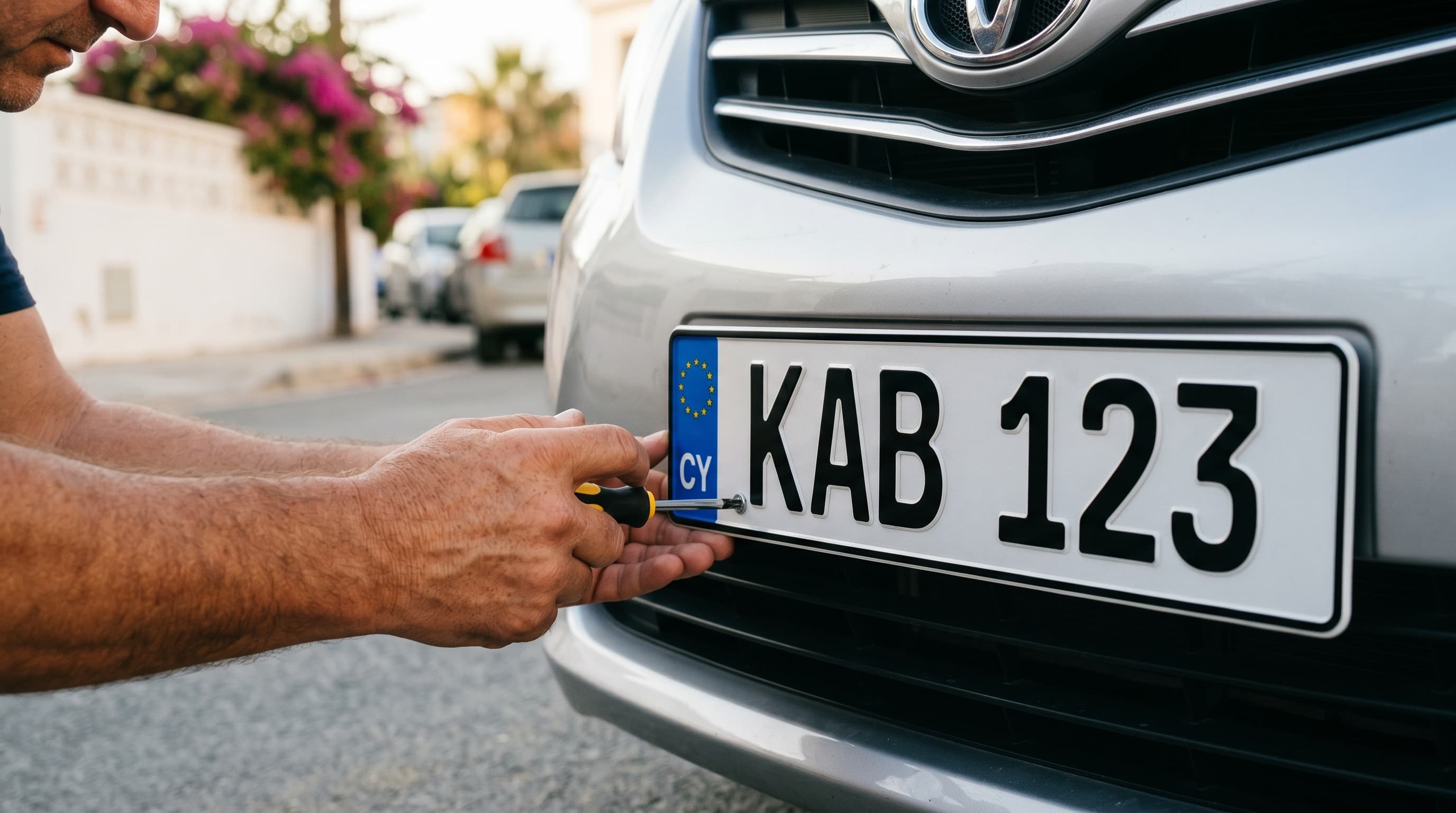
How it works in practice depends on the route:
- Temporary import. Driving an imported car on foreign plates inside Cyprus for up to six months requires either a Cyprus-domiciled motor insurance policy on the foreign plate, or an EU Green Card extension covering Cyprus on the home-country policy. Foreign comprehensive cover without a Green Card extension does not satisfy Law 96(I)/2000 once the vehicle is in Cyprus.
- Permanent import. The vehicle must hold a Cyprus-domiciled motor insurance contract from day one of registration.
- Cover Note. Where the full insurance certificate (the Pink Slip) needs additional underwriting time, the broker issues a Cover Note as immediate proof. The Cover Note carries full legal weight for plate issuance.
How do insurers bind cover before a plate exists? They use the chassis number (VIN). Our agents write the policy against the VIN on the day customs clears, and once the RTD allocates a Cyprus plate within the 10-day window, the certificate is reissued with the plate number on it. This is why an experienced insurance agency can produce a Cover Note the same morning Form C72A is issued.
One detail worth getting straight: marine cargo insurance is not motor insurance. Marine cargo covers the vehicle while it sits in the ship's hold or container; it expires when the car rolls off the dock and does not satisfy Cyprus motor insurance law.
If you are arranging the shipping leg yourself, the cover on the vehicle as freight is marine cargo insurance, and it is rated on the CIF value plus ten per cent rather than on the car's road risk.
Get a same-day Cyprus motor quote. Your Cover Note bridges the 10-day window between customs clearance and number plates.
Get a Free QuoteHow long does importing a car to Cyprus take?
End-to-end, expect 4 to 10 weeks from purchase abroad to Cypriot plates, depending on origin and how well the SVA slot is booked. Each step has its own timeline.
Shipping UK to Cyprus:
2 to 4 weeks by RoRo through Limassol Port.
Shipping Japan to Cyprus:
4 to 6 weeks.
Customs clearance:
1 to 3 working days at the Cyprus Customs & Excise office once all documents are presented.
SVA inspection:
typical queue 1 to 2 weeks; test itself takes 1 day.
RTD registration:
2 to 3 working days from documents stamped to plates issued.
Practical port-day notes: visitors entering Limassol Port pay around €3 for a port pass, batteries often need a jump-start after weeks at sea (budget around €10 for callout), and the vehicle should not be driven off the dock without a temporary insurance certificate in hand.
How origin affects import rules: UK, EU and Japan
The vehicle's country of origin changes the duty rate, the documentation required and the shipping window. The table below summarises the three routes that account for almost all expat imports to Cyprus.
Customs duty, VAT and shipping by origin (Cyprus 2026)
| Rule | UK (post-Brexit) | EU | Japan |
|---|---|---|---|
| Import duty | 0% with Statement of Origin; otherwise 10% | 0% (Free Circulation) | 10% on CIF value |
| VAT | 19% (waived under TOR) | 19% only on new means of transport | 19% on CIF value |
| Origin proof | Statement of Origin or WVTA on V5C point K | EU Certificate of Conformity | Japan export certificate |
| Shipping window | 2 to 4 weeks (RoRo) | 1 to 3 weeks | 4 to 6 weeks |
| Special note | Notify DVLA permanent export via V5C/4 | New means of transport rule overrides 0% VAT path | Dual-language infotainment; auction-sheet authenticity |
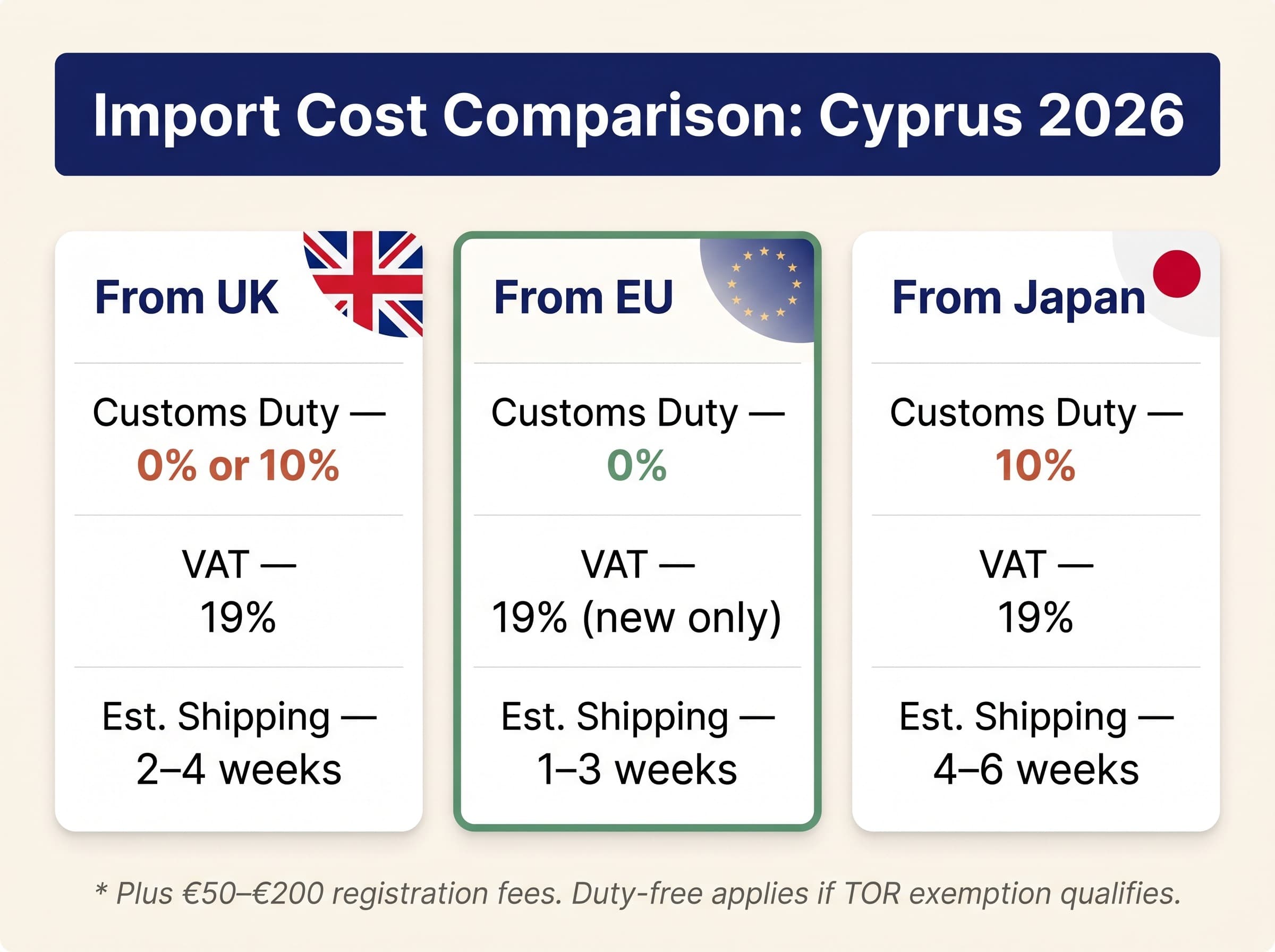
For UK-origin vehicles, the Statement of Origin is the one document that drops duty from 10% to 0%. Ask the UK dealer for it at purchase. For EU vehicles, the Certificate of Conformity bypasses both customs duty and SVA inspection. For Japan vehicles, fake auction sheets and undisclosed structural damage are well-documented risks among Cyprus importers (a pre-purchase VIN check and a non-broker inspector at the export port reduce that risk). For the UK route, also note the DVLA permanent export step (Form V5C/4), which Cyprus Customs may ask to see.
The five-year age limit applies equally to all three origins and disqualifies the bulk of older Japan imports unless the buyer qualifies for TOR. Russian-registered vehicles cannot be imported to Cyprus under any route due to the EU sanctions package in force since February 2023.
Common mistakes and how to avoid them
Buying a Japan car over 5 years old without TOR eligibility.
The five-year age limit is measured port-arrival against Date of First Registration, not purchase date. A car bought as 2019 but first-registered 2018 may fail by months.
Missing the 10-day registration window after Form C72A.
The clock starts on C72A issuance, not on first inspection availability. Book the Single Vehicle Approval slot while the vehicle is at sea.
Assuming home-country insurance is valid on Cypriot plates.
It is not. The moment the RTD issues Cyprus plates, only a Cyprus-domiciled motor policy under Law 96(I)/2000 keeps the vehicle legal.
Confusing marine cargo insurance with motor insurance.
Marine cargo expires at the dock and covers the vehicle as freight, not as a road vehicle. The driver needs a separate motor policy or Cover Note before the car leaves the port.
Entering TOR without planning around the 3-year resale lock.
Selling a TOR-imported vehicle within 36 months triggers retroactive payment of both the waived 10% duty and 19% VAT, plus penalties.
Industry experience consistently flags VIN-verification and structural-history checks as the biggest single fix for Japan-origin imports, where seller-side documentation is harder to corroborate.
Compare car insurance from 10+ Cyprus insurers — third-party cover from €180 per year.
Compare car insuranceFrequently asked questions
Get the sequence right the first time
Importing a car to Cyprus rewards a clear sequence and punishes improvisation. Customs clearance produces Form C72A. Form C72A starts a 10-day clock. Inside that clock, you complete inspection at the Cyprus Department of Road Transport, bind a Cyprus motor insurance policy, and collect white plates. Skip the insurance step and the plates do not get issued.
DigiCare Insurance issues same-day Cover Notes for imported vehicles against the chassis number, then reissues the Pink Slip against the plate number once the RTD has registered the car. That keeps the 10-day window open whatever the SVA queue looks like.
Ready to import? Your Cover Note bridges the 10-day window between customs clearance and number plates.
Get a same-day Cyprus motor quoteImporting a car to Cyprus? We bridge the 10-day window with a same-day Cover Note.
Get a Free Quote