
- >
- Blog >
- Yellow Slip Cyprus 2026: MEU1 Guide, Documents, €20 Fee and Appointments
Yellow Slip Cyprus 2026: MEU1 Guide, Documents, €20 Fee and Appointments

€20
Government fee
per applicant, MEU1, MEU2 and MEU3 alike
gov.cy, Migration Department, 2026
4 months
Deadline to apply
from the date of entry into the Republic
Law 7(I)/2007 art. 10(1); gov.cy, 2026
3 months
Stay that triggers it
below that, no formality beyond your passport
Law 7(I)/2007 art. 10(1); gov.cy, 2026
Up to €2,500
Late-registration maximum
a statutory ceiling, not a flat fine
Law 7(I)/2007 art. 10(3); gov.cy, 2026
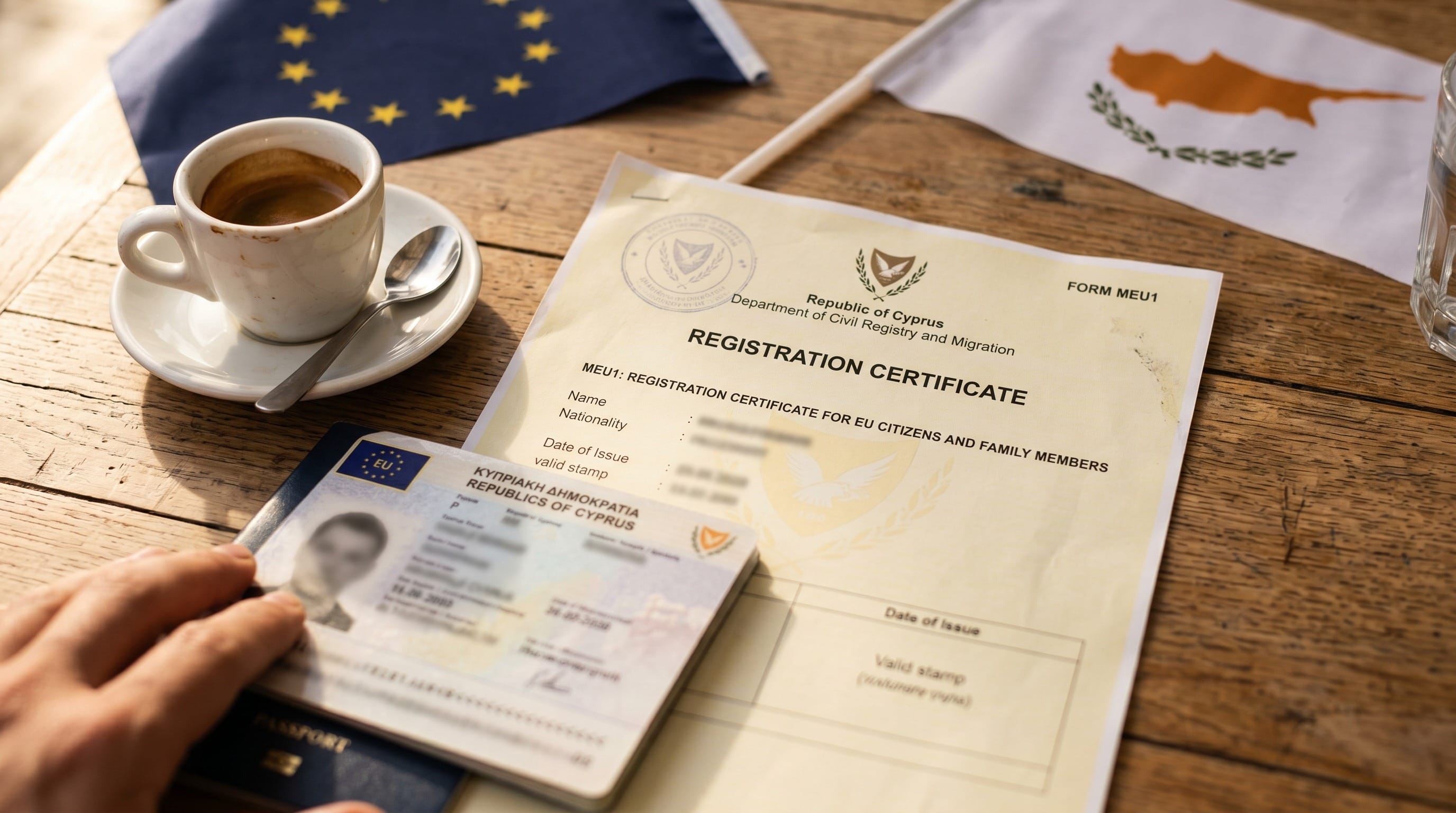
Yellow Slip Cyprus is what most people call the MEU1 registration certificate, and at DigiCare Insurance we place the health cover that sits behind those applications every week. It is the document EU, EEA and Swiss citizens file for any stay longer than three months, and the questions we get are rarely about the €20 fee. They are about which form to fill in, how to book an appointment now that the online portal has gone, and whether an EU citizen has to buy a policy at all.
This guide is built on the Migration Department's own published documents: the MEU1 application form and the supporting-documents checklist posted on gov.cy on 29 December 2025, the appointment instructions posted on 19 December 2025, the department's MEU1, MEU2 and MEU3 pages, and Law 7(I)/2007 itself. Where a figure circulates online without a government source behind it, we say so instead of repeating it.
If you hold a non-EU passport, MEU1 is not your route at all. The permit that replaces it is the Pink Slip, for non-EU nationals: a different form, a medical examination, and a separate insurance certificate.
What is the Yellow Slip in Cyprus (MEU1)?
gov.cy now publishes as the Migration Department, under the Deputy Ministry of Migration and International Protection. Older material still carries the previous name: the appointment sheet the department links to today opens "The Civil Registry and Migration Department announces". CRMD and Migration Department mean the same office. The rename also split the work: the Migration Department, formerly the Civil Registry and Migration Department, keeps residence permits, while births, marriages and identity cards stayed with the Civil Registry Section of the Ministry of the Interior.
The Yellow Slip is not a visa, not a work permit and not a Schengen document. EU citizens already hold the right to enter, live and work in Cyprus under free movement law; the MEU1 records that you have moved, it does not grant permission. Cyprus is outside the Schengen Area, so the certificate is not a travel document and your passport still goes with you.
Who needs one, and by when?
For the first three months nothing is required at all. In the department's words, Union citizens and their Union-citizen family members "have the right of residence for a period of up to three months without any conditions or any formalities other than the requirement to hold a valid identity card or passport".
Past that point, article 7(1) of Directive 2004/38/EC and article 9(1) of the Cyprus law give the right of residence to four groups, and the MEU1 is how each of them registers:
- Workers and self-employed people: employed or trading in Cyprus.
- Students: enrolled at a public or private establishment for the principal purpose of study, who hold sickness cover and can declare sufficient resources.
- Self-sufficient residents: including retirees, who have sufficient resources not to become a burden on the social assistance system and hold comprehensive sickness insurance.
- Family members who are themselves Union citizens: joining a Union citizen who qualifies under one of the routes above.
Non-EU family members do not use the MEU1. They apply for the MEU2, within the same four months.
Registering late is not a paperwork slip. Article 10(3) makes non-compliance an offence, and the ceiling is €2,500. That is covered in full further down.
MEU1, MEU1B, MEU2 or MEU3: which form do you need?
There is one procedure name and several documents under it. MEU1 is the registration certificate for Union citizens, MEU2 is the residence card for their non-EU family members, and MEU3 is the permanent document both groups reach after five years.
MEU1, MEU2, MEU3 and the UKW documents compared
| Document | Who it is for | Fee | Decision time | Validity |
|---|---|---|---|---|
| MEU1 (form MEU1B) | EU, EEA and Swiss citizens, plus family members who are also Union citizens | €20 | Within 1 month | No expiry date |
| MEU2 | Non-EU family members of a Union citizen | €20 | Within 6 months | 5 years |
| MEU3 | Union citizens after 5 years, and their non-EU family members after 5 years | €20 | Within 6 months | Non-EU family card: 10 years, renewable |
| UKW1 / UKW2 / UKW3 | UK nationals and their family members covered by the Withdrawal Agreement | €30 | Varies | UKW1 and UKW2: 5 years. UKW3: 10 years |
MEU1B is the application form itself, not an annex
The form published on gov.cy is headed "Application for issue of Registration Certificate of Union Citizen and his/her family members also EU citizens", and it carries the number MEU1B. Everyone applying for a Yellow Slip fills it in. The income declaration that some guides describe as a separate MEU1B annex is Part V of that same form, completed only when your income does not come from employment. Its six parts run: particulars of the Union citizen, particulars of Union-citizen family members, employment, self-employment, other income, and the signed declaration.
Both files sit on the gov.cy MEU1 forms page, posted on 29 December 2025: the MEU1B application form and the supporting-documents checklist. Both are Word documents rather than PDFs, which catches people out on a phone. If you find a form headed MEU1A on a university or third-party site, it is not the current pack.
How do I book a Yellow Slip appointment in my district?
The department's appointment instructions, posted on 19 December 2025, ask people living outside Nicosia to "contact the competent District Unit of the Aliens and Immigration Service of the Cyprus Police in their district of residence to arrange an appointment". EU registration is not one of the categories examined only at headquarters, so it is a district matter.
Where to go and how to arrange it, by district
| District | Where you go | How to arrange it |
|---|---|---|
| Nicosia | Migration Department, 90 Archbishop Makariou III Avenue, 1077 Nicosia | Call the EU nationals and family members line, 22308808 / 22308811, to confirm the current arrangement |
| Limassol | Police Aliens and Immigration Unit, 223 Franklin Roosevelt, Zakaki, "D. Nikolaou" building, 2nd floor, 3046 | limetiseis@police.gov.cy · 25805650 / 25805210 |
| Larnaca | Police Aliens and Immigration Unit, 34 Tasou Mitsopoulou, 6027 | larnacaetiseis@police.gov.cy · 24804233 / 24804236 |
| Paphos | Police Aliens and Immigration Unit, 22 Eleftheriou Venizelou and Kanigos corner, 2nd floor, 8021 | pafosetiseis@police.gov.cy · 26806222 / 26806215 |
| Famagusta | Police Aliens and Immigration Unit, 31 G. Papadopoulou, 5282 Paralimni | famagustaetiseis@police.gov.cy · 23803286 / 23803288 |
Opening hours, from the department's own service-hours page: the Migration Department in Nicosia runs 08:00 to 14:30 with last entry at 14:00, and the police units run 07:30 to 14:30, Monday to Friday except public holidays. The addresses above are published by the Cyprus Police and the phone numbers appear on both the police site and the department's contact sheet, so confirm by email before you travel across the island.
For Nicosia the instructions stop at the contact lines. The page's "first come, first served, without the need for a prior appointment" sentence sits inside a special-arrangements block scoped to those eleven headquarters-only categories, so it does not describe Yellow Slip applicants either. Call the EU nationals and family members line, 22308808 or 22308811, and confirm the arrangement before you travel.
One reason the published guidance disagrees with itself: the old online booking platform was shut down on 20 March 2023, after agents bulk-bought appointment slots and resold them, as the Cyprus Mail reported at the time. Its address still resolves today and still serves a live booking widget, so a dead service looks alive and the same broken route keeps being republished.
The department's contact sheet sets out exactly what the email has to contain, and requests that leave a field out are the ones that go unanswered:
- Name and surname, date of birth, nationality, passport number
- Date of last arrival in Cyprus
- Aliens Registration Number (ARC), where you already have one
- Expiry date of any existing residence permit, and the file number (MP)
- Number of people applying, and a local telephone number
- All personal details written in capital letters
Send one request per family, not one per person, and do not resend it while you wait: the department answers within five working days. One line in that sheet asks for the appointment to be arranged at least one month before an existing permit expires, which is written for renewals. If this is your first registration you have no permit to expire, so the timing that binds you is the four-month deadline.
We keep a separate guide to each office: Nicosia, Limassol, Larnaca, Paphos.
What documents are required?
Every applicant
- Copy of a valid passport or national identity card, with the original produced at submission
- The MEU1B form, completed and signed
- Marriage or civil-partnership certificate, certified and translated where it is foreign, plus a divorce, dissolution or death certificate where one applies
- Children's birth certificates
- Title deed of immovable property, or a rental agreement stamped by the Superintendent of Stamping and certified by a certifying officer as to the signatures of landlord and tenant, with the original rent receipts. The certifying officer is usually the Muhtar at your local community council office
- An original utility bill in the tenant's name, from the Electricity Authority of Cyprus or the water supply, showing the address that becomes your official postal address
Employed applicants
- Part III of the MEU1B, signed and stamped by the employer, with a salary certificate
- Certificate of registration with the Social Insurance Services, and a detailed statement of contributions naming the last employer and the salary
Self-employed applicants
- Part IV of the MEU1B, the declaration of self-employment
- Proof of social insurance contributions for the last four months
Students, pensioners and other applicants who are not working in Cyprus
- Evidence of the residence basis: enrolment for students, pension statements for retirees, proof of income or deposits for self-sufficient applicants
- Health cover as set out for your category in the next section
- For a dependent direct ascendant, an oath declaration of responsibility for expenses and hospitality signed by the Union citizen
- For the spouse of a Cypriot citizen, a declaration of harmonious cohabitation certified by the Parish President or Community Council President
That property item is where applications come apart. The checklist asks for the owner's and tenants' names, identity numbers, the ARC of a foreign or European tenant and contact numbers on the rental document itself.
On income, Cyprus immigration advisers report €4,613 a year for a single applicant plus €1,230 for each dependent, but no threshold is published, and article 8(4) of Directive 2004/38/EC bars a member state from laying down a fixed amount at all. The statute asks instead for stable income from employment abroad, income from other lawful sources, or deposits of sufficient size in a bank in Cyprus or abroad.
Documents from another EU member state may not need an Apostille, but the exemption is narrower than it is usually described. Regulation (EU) 2016/1191, in force since 16 February 2019, removes the legalisation requirement for a listed set of civil-status public documents such as birth, death, name, marriage and divorce certificates. Anything outside that list still follows the department's ordinary document ratification rules.
How do I apply, step by step?
Applications are made in person at the office for your district, and the decision is posted to you afterwards.
Check that you are inside the window
. Registration applies to stays longer than three months, and the application is due within four months of the date you entered the Republic.
Download the two Word files
from the gov.cy MEU1 forms page: the MEU1B application form and the supporting-documents checklist for your category.
Arrange the appointment
. Outside Nicosia, email or telephone the district police unit and wait for the reply. In the Nicosia district, call the Migration Department's EU nationals and family members line first to confirm the arrangement.
Assemble the documents for your category
, originals plus a copy, with the rental agreement stamped and certified before the day.
Attend in person and pay the €20
. Non-EU family members applying for the MEU2 are fingerprinted at this stage.
Wait for the decision
. gov.cy states that the examination and decision are "completed within one month at the latest", provided the file is complete, and that an approved Registration Certificate is "sent by post".
Do I need private health insurance for the Yellow Slip?
That checklist, published on 29 December 2025, is an administrative document list rather than a statute, and it is the closest thing to a definitive answer because it is what the counter actually asks for. Here is what it says, category by category, in the department's own category names.
Health cover for the Yellow Slip, by applicant category
| Category | What the checklist asks for | Do you buy a policy? | Typical cost |
|---|---|---|---|
| Employed or self-employed | Employed: Social Insurance registration and a contributions statement naming the last employer and salary. Self-employed: a certificate of contributions for the last 4 months. No health-insurance item | No | €0 |
| Paying social insurance in another EU state (form A1) | Form A1 plus "health insurance covering inpatient, outpatient and body transport costs". No GeSY alternative is offered | Yes | From €120 a year |
| Involuntarily unemployed | A policy covering in-patient care, out-patient care and body transport costs, or a GeSY registration certificate | Unless you use the GeSY route | From €120 a year |
| Student | A policy covering in-patient care, out-patient care and body transport costs, or a GeSY registration certificate, or a European Hospitalization Card | Only if you hold none of the three | From €120 a year |
| Minor or dependant under 21 | A policy covering in-patient care, out-patient care and body transport costs, or a GeSY registration certificate, where applicable | Where applicable | From €120 a year |
| Dependent direct ascendant, and visiting pensioner | A policy covering in-patient care, out-patient care and body transport costs, or for pensioners the E121/S1 processed through the Ministry of Health, or a GeSY registration certificate | If you have neither an S1 nor GeSY | From €120 a year |
| Spouse of a Cypriot citizen | A policy covering in-patient care, out-patient care and body transport costs, or a GeSY registration certificate | If you are not registered with GeSY | From €120 a year |
The checklist publishes 6 category sheets. The employed sheet carries three separate situations, shown here as three rows, and the dependent ascendant and visiting pensioner sheets carry the same line, shown here as one. Every insurance line asks for the same three components. The English file also names "medical care" in three of the seven lines and omits it from the other four, where the Greek names it in all seven as the head noun the in-patient and out-patient adjectives attach to, so that is a difference in the English phrasing rather than in the requirement. The GeSY alternative is written here as the Greek original writes it; the English file adds body transport costs to it, which is the discrepancy set out below. Cost column: our own from-price for a policy carrying in-patient, out-patient and body-transport cover. Government fees are separate and are set out further down.
Two things follow that are worth reading twice. The European Hospitalization Card, which UK arrivals know as the GHIC and everyone else as the EHIC, appears in the student row and in no other row. Outside the student category it is not on the department's list, which is why applicants in other categories report having a card turned down at the counter. That is consistent with how the EU itself frames the card: Your Europe files it under unplanned treatment during a temporary stay, and on its living-abroad branch still offers the card to non-employed students, which is the one category Cyprus accepts it in.
The second is the A1 cohort. A Union citizen working in Cyprus but paying social insurance in another EU country has to produce form A1 and a policy covering inpatient, outpatient and body transport costs, and it is the one work route where no GeSY alternative is offered. Posted workers and cross-border employees sit here, and almost nothing written about the Yellow Slip mentions them.
For pensioners, the route runs through the Ministry of Health: you evidence your cover with the E121 or S1 processed there, or with a GeSY registration certificate. An S1 is not a GeSY registration in itself, so do not assume the two are interchangeable.
There is no minimum sum insured to hit, and the proof is an absence: no article of the directive and no article of the Cyprus law names a sum for sickness cover. The one fixed amount that is forbidden is a different thing. Article 8(4) of Directive 2004/38/EC states that member states "may not lay down a fixed amount which they regard as 'sufficient resources' but they must take into account the personal situation of the person concerned", and that is about income and savings rather than medical cover. The Cyprus law asks in the same qualitative terms for "full sickness insurance cover in the Republic". Any figure you see quoted as an EU minimum, €30,000 included, belongs to a different regime: that one is the Schengen visa medical-insurance rule for third-country nationals.
One naming note, because it causes real confusion. The checklist writes a lower-case "(plan A)" after each of those lines. That is the department's own shorthand for a schedule covering in-patient care, out-patient care and body transport. DigiCare also sells a product called Plan A, which is the immigration medical certificate for non-EU applicants on the Pink Slip path. The two are unrelated wording, and our guide to yellow slip and pink slip health insurance sets out which document each route needs.
Two of these routes have a guide of their own: how to register for GeSY if you are working here and the GHS certificate is the evidence you will use, and private health insurance for Cyprus expats if you are self-sufficient or retired and choosing a policy.
If you want the short version of this question on its own page, we answer whether EU citizens need health insurance for the Yellow Slip separately, and go one level narrower on whether an EHIC or an S1 form is enough for the Yellow Slip, the two documents EU applicants most often arrive holding. This section carries the fuller answer, category by category.
Where cover is asked for, our advisers place a policy carrying those three components, in-patient, out-patient and body transport, as comprehensive sickness cover for MEU1 from €120 a year, issued as a Cyprus certificate you can take to the counter.
Applicants report that district offices differ in how strictly they read the cover requirement. The published requirement is the same nationwide.
Need the comprehensive sickness cover your MEU1 category asks for? We issue a Cyprus certificate with in-patient, out-patient and body-transport cover, usually the same day by email.
Get a Yellow Slip insurance quoteHow much does the Yellow Slip cost?
What a Yellow Slip application actually costs
| Cost item | Typical price | Notes |
|---|---|---|
| Government fee | €20 per applicant | Paid at submission |
| Sworn translation | €25 to €50 per page | Typical market range, not a published fee. Only for documents that are not in Greek or English |
| Comprehensive sickness cover | From €120 a year | DigiCare's own from-price. Only for the categories above that ask for it |
| Certifications and stamps | Varies | Stamping and certification of the rental agreement |
| UKW biometric document | €30 per person | UK nationals on the Withdrawal Agreement route |
Higher numbers circulate for a reason worth knowing. Some are all-in estimates that fold in translations, certifications and travel; others are the late-registration penalty rather than the fee. The government fee itself has not moved: it is €20, and you pay it at the cashier on the day you submit.
What happens if you register late?
Read that as a maximum rather than a price list. The statute sets one ceiling and no tiers, and a court decides what falls below it. Cyprus immigration advisers report that in practice the penalty is applied on a sliding scale according to how late the registration is, but we could find no published tiered scale anywhere: the Migration Department does not publish one, and the statute sets a single maximum of €2,500.
The practical answer is that late registration is worth avoiding rather than worth pricing. Book the appointment as soon as you know you are staying, because the four-month clock runs from your arrival, not from the day the district office has a free slot.
Does the Yellow Slip expire, and how do you renew or replace it?
The six-month rule that fills the forums is a different rule about a different thing. Article 16(3) of Directive 2004/38/EC says continuity of residence "shall not be affected by temporary absences not exceeding a total of six months a year", plus longer absences for compulsory military service and one absence of up to twelve consecutive months for reasons such as pregnancy and childbirth, serious illness, study, vocational training or a posting abroad. Six months in total across the year, then, rather than six consecutive months, and it governs the five-year count towards permanent residence, not the validity of the certificate in your drawer. Once permanent residence is acquired, article 16(4) says it is lost only through absence exceeding two consecutive years.
If your certificate is lost or damaged, the department's frequent questions page sets out the route:
Report the loss to the Police
and obtain the certificate recording your declaration of the loss.
Go to one of the application submission offices
with that certificate and your identification documents.
Submit a new application and pay the reissuance fee
. The amount is not published, so ask when you book, and do not assume it matches the €20 first-application fee.
Keeping your address current is your responsibility, and the department publishes a Declaration of Mailing Address form for it. Since the certificate arrives by post, an out-of-date address is a real risk.
The digital service that launched in July 2026 does not change this either. Online permit renewal in Cyprus is open to third-country nationals only, so an EU citizen holding MEU1 or MEU3 sits outside it entirely.
MEU3: permanent residence after five years
The name covers both groups, which the department's own index obscures: its frequent questions page lists "Permanent residence of E.U./E.E.A. citizens and members of their families who are also E.U./E.E.A. citizens (MEU3)" alongside the version for third-country family members, both under the same form number.
MEU1 vs MEU3
| MEU1 | MEU3 | |
|---|---|---|
| When you apply | Within 4 months of arrival | After 5 years of continuous residence |
| Who applies | Union citizens and Union-citizen family members | The same, plus their non-EU family members |
| Fee | €20 | €20 |
| Decision | Within 1 month | Within 6 months |
| Validity | No expiry date | Permanent. Non-EU family card: 10 years, renewable |
| What breaks it | Nothing: it does not expire | Absences over six months a year break continuity before the five years are up. After that, only two consecutive years away |
The current document list for the MEU3 sits on the department's MEU3 page. Start collecting proof of your five years early: rental agreements, utility bills, contributions statements and tax records are the ordinary evidence, and they are easier to gather as you go than to reconstruct in year five.
MEU3 is one of four routes to permanent residency in Cyprus, and the only one an EU passport opens by itself. A non-EU spouse reaches it through the same five years, and may also qualify for Category F, for long-term resident status or for the investment permit on their own account. We set out how MEU3 compares with Category F, long-term residence and the investment permit on income, fee, waiting time and the health cover each route asks for.
Yellow Slip vs Pink Slip
Yellow Slip vs Pink Slip at a glance
| Yellow Slip (MEU1) | Pink Slip (temporary residence permit) | |
|---|---|---|
| Who it is for | EU, EEA and Swiss citizens | Non-EU nationals |
| Validity | No expiry date | 1 year, renewable |
| Work rights | Automatic | Restricted, usually a separate permit |
| Health cover | Depends on category (see above) | Immigration medical insurance |
The two are different physical objects, which settles the question people ask after a counter visit. The Yellow Slip is a paper Registration Certificate. The Pink Slip has been issued since around 2020 as a plastic biometric card, also called the Pink Card or Temporary Residence Card. If you are holding paper and an EU passport, you are holding the MEU1. Neither document is an ARC, and whether EU citizens are given an ARC at all is a question the department's own MEU1 page never answers.
Pink Slip applicants also sit a medical examination that Yellow Slip applicants are never asked for. If that is your route, read our Cyprus residence permit medical examination guide and our immigration medical insurance page before you book.
What to do after you receive it
The certificate arrives by post. Five things follow it:
Register with GeSY
at gesy.org.cy if you are working or self-employed in Cyprus.
Get your Social Insurance number
from the Ministry of Labour and Social Insurance, if your employer has not already registered you.
Open a Cypriot bank account
. Applicants report that banks ask to see the MEU1 as proof of residence.
Apply for a Tax Identification Code
at the Tax Department, and work out your tax residency: the default test is 183 days in Cyprus, and a 60-day rule exists for people who meet its conditions.
Store the certificate flat and unlaminated
. It is paper, it is the original, and applicants report laminated certificates being refused at government counters. Plan for the MEU3 at year five.
Yellow Slip and UK nationals after Brexit
The department's own page for UK nationals, posted on 30 December 2025, puts it as a right rather than an obligation: eligible UK nationals "are entitled to retain their previous residence document as EU citizens and can use them as means of proof of their right to reside", and have the right "if they wish" to obtain the new document. The UK government's Living in Cyprus guidance recommends making the exchange, and also names no deadline.
One point of confusion is worth naming, because a UK reader has almost certainly met it. Cyprus immigration advisers widely publish 3 August 2026 as a deadline for exchanging the paper MEU1 or MEU3 for the biometric card. Neither the Cyprus government nor the UK government publishes that date, or any date. Under the declaratory system a pre-transition-period resident's existing MEU1 or MEU3 stays valid proof of their rights, so the exchange is worth making on its own merits and not because a deadline has passed you by.
The new documents come in three forms. UKW1 is for UK nationals and UK-national family members, UKW2 for third-country dependent family members, and UKW3 is the permanent document after five years of continuous lawful residence. Each costs €30 per person. UKW1 and UKW2 run for five years; UKW3 runs for ten and is renewed on application and payment of a further €30. A photograph, fingerprints and a signature are taken, with fingerprints and signature not required under age six. Non-EU family members holding an MEU2 may use it until it expires and are required to apply for the new document. Eligibility turns on residence exercised before the end of the transition period, under articles 35Α and 35Ζ of Law 7(I)/2007.
Frequently asked questions about the Cyprus Yellow Slip
Final thoughts
The Yellow Slip is a short application resting on a long document list, and almost every refusal we hear about comes from the same two places: a rental agreement that was not stamped and certified, and a health-cover item that did not match the applicant's category. Get those two right and the €20 fee is the least of it.
DigiCare Insurance is a licensed Cyprus insurance agency, ICCS licence 2451, working in Cyprus since 2009. If your category is one that asks for cover, our advisers issue the certificate DigiCare provides with in-patient, out-patient and body-transport cover, usually the same day by email. If you hold a non-EU passport, the Pink Slip route is yours instead, and our immigration medical insurance page is the place to start.
A note for students: if you study in Cyprus on a non-EU passport, this guide is not your route. You need the Pink Slip and a student policy, which we cover in our guide to student visa health insurance for Cyprus.
Need comprehensive sickness cover for your MEU1 Yellow Slip application?
Get a Free QuoteNeed comprehensive sickness cover for your MEU1 Yellow Slip application?
Get a Free Quote