
Commercial Transport Cover · Limassol · Nicosia · Paphos
Goods in Transit Insurance in Cyprus
Cover for the stock, tools and equipment in your vehicles, from a licensed Cyprus insurance agency comparing 10+ insurers. Your own goods, or goods you carry for customers.
Goods in transit is class 7 «Μεταφερόμενα εμπορεύματα» under Law 38(I)/2016. It is not compulsory in Cyprus, and section 4(2) of Law 96(I)/2000 says the compulsory motor minimum need not cover the load.

10+
Insurers compared
15+
Years in Cyprus
2451
ICCS licence
The Cyprus insurers we place







DigiCare Insurance arranges goods in transit insurance covering your stock, tools and equipment while they move by road in Cyprus. It is not compulsory, and section 4(2) of Law 96(I)/2000 says the compulsory motor minimum need not cover goods being loaded, unloaded or carried. Premiums are quoted on your any-one-vehicle limit and your annual carryings.
Get a goods in transit quoteWhat it covers
What goods in transit insurance covers in Cyprus
Goods in transit insurance covers goods, stock, tools and equipment against loss or damage while they are carried by road in Cyprus. Cyprus law files it as class 7, the class used for goods being carried. You can buy it on specified perils, or on all risks.
Class 7 is «Μεταφερόμενα εμπορεύματα» in the First Schedule to Law 38(I)/2016, and the statute defines it as damage to goods being carried «οποιοδήποτε και αν είναι το μεταφορικό μέσο»: whatever the means of transport. The same class applies whether the goods go by sea or in a van between Limassol and Nicosia.
Two shapes are sold here. Specified perils names the events that pay: fire, theft, accidental damage, collision and overturning. All risks pays for any accidental loss the policy does not exclude, costs more, and argues less at claim stage.
Cover attaches when the goods are first moved for conveyance to a destination outside your premises, and ends when they are delivered at the final destination. That clause does more work than it looks. It brings loading and unloading inside the policy, and it is why a parcel sitting in your yard after a failed delivery is worth asking about.
Cyprus policies are commonly written to the geographical boundaries of the Republic of Cyprus. If you deliver beyond the areas under the effective control of the Republic, ask your insurer to confirm in writing whether cover follows the vehicle there.
Tools in transit usually sits on its own limit rather than inside the stock figure. I get asked about it weekly by electricians, plumbers and air-conditioning engineers. A van full of tools is a bigger number than owners guess.
Who buys this in Cyprus
Distributors and wholesalers running their own delivery vans
Food and drink distributors moving chilled and frozen stock
Electrical, appliance and furniture retailers delivering to customers
Builders' merchants and plant movers on site runs
Tradespeople carrying tools and materials in a van
Couriers and last-mile firms moving goods for a fee
Limassol port drayage operators running containers inland
The motor boundary
Does your motor policy cover the goods you carry?
Not automatically. Section 4(2) of Law 96(I)/2000 says the cover a motor policy is required to provide need not include damage to property during loading, unloading or carriage in or on the vehicle. Cover for your load is an extension you have to have bought.
First, a word for anyone who arrived here searching the statute number. Law 96(I)/2000 is Cyprus's compulsory third-party motor liability law, and its minimum limits cover injury to people and damage to other people's property. They have nothing to do with the value of the goods in your van. If the motor policy itself is what you wanted, that is commercial fleet insurance.
Section 4(2) of Law 96(I)/2000 lists what the required cover «δεν απαιτείται να περιλαμβάνει», and limb (δ) reads: «ζημιά σε οποιοδήποτε περιουσιακό στοιχείο κατά τη φόρτωση, εκφόρτωση ή μεταφορά μέσα ή πάνω στο όχημα». In plain English, the law does not make a motor policy pay for property damaged while it is being loaded onto, unloaded from, or carried in or on the vehicle. Those are the three things that happen to your stock every working day.
Read that carefully. The statute says the required cover need not include your load. It does not say an insurer cannot cover it. So the honest sentence is this: anything covering your load is an extension you have to have bought, not something the compulsory policy hands you.
The call I take most often starts the same way: there was a claim, the van was insured, and nobody had ever been asked whether the load was. Read your motor schedule before you need it, not after. Costas Matheou, licensed insurance agent, DigiCare Insurance
Part B of the First Schedule to Law 38(I)/2016 puts class 3, the vehicle, class 7, the goods carried, and class 10, motor liability, into one licence group. So Cyprus law licenses your motor insurer to cover your load and, in the same breath, declines to compel it. Being authorised to write two classes is not the same as putting both in one policy. The cover exists, it sits with the same insurer, and it is optional, which is exactly why so many businesses assume they already have it.
Three things to check on your motor schedule
The limit for any one vehicle. One flat figure across a mixed fleet leaves your busiest van short.
Whether goods left in the vehicle overnight are covered, and on what conditions.
Whether loading and unloading are included, since a lot of damage happens there.
For scale, the compulsory motor minimums under Law 96(I)/2000 are €38,600,000 for bodily injury and €1,300,000 for third-party property. Neither responds to the value of your load. They protect other people, not your cargo.
One more limb of section 4(2) is worth knowing. The compulsory cover also need not include damage to a bridge, weighbridge, flyover or the road itself caused by the weight of the load. If you run containers out of Limassol or move plant on a low-loader, that is a real exposure.
Sources for this section
Two products, one name
Own goods or carrier's liability: which cover do you need?
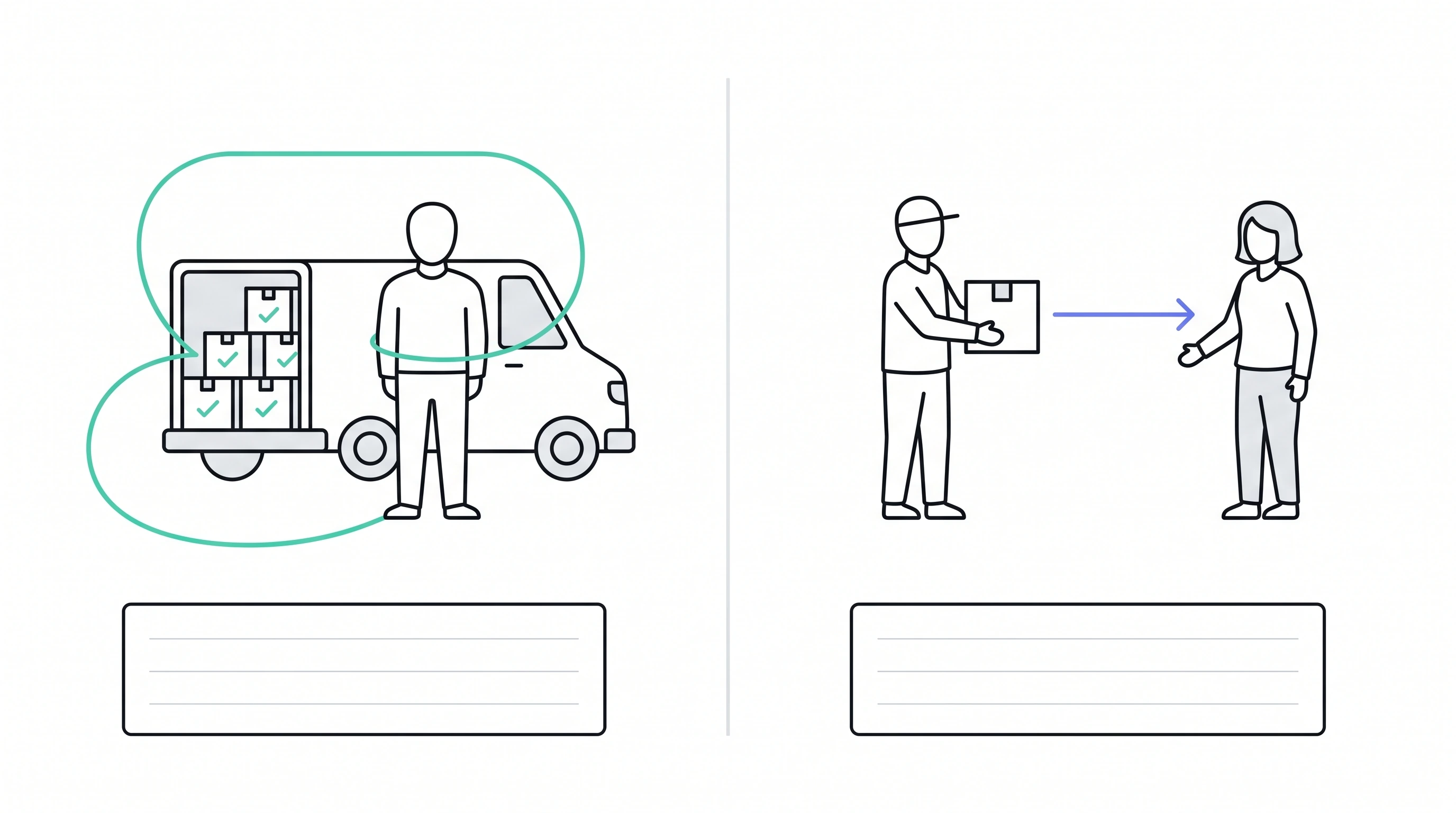
If you move your own goods, you need own-goods cover, and it pays you for your goods. If you move other people's goods for a fee, you need carrier's liability, and it pays your customer only when you are legally liable, and only up to the limit in your conditions of carriage.
This is the question I ask first on every call, because buying the wrong one is worse than buying nothing. Two contracts are sold under one search term, and no Cyprus insurer page I have read separates them.
Own goods in transit
Who is insured · You, as the owner of the goods
What triggers a payment · The goods are lost or damaged in transit, whoever was at fault
What it pays · The value of your goods, up to the limit for any one vehicle
Carrier's goods in transit liability
Who is insured · You, as the haulier, courier or removals firm
What triggers a payment · You are proved legally liable to the customer whose goods you carried
What it pays · What you owe that customer, capped by your conditions of carriage
Own-goods cover pays for your goods. Carrier's liability pays your customer only when you are legally liable, and only up to the limit in your conditions of carriage.
There is no Cyprus statute fixing what a haulier owes you for goods lost on a domestic run. The CMR Convention only bites when goods start and finish in different countries. The Carriage of Goods by Sea Law is scoped from one port to another. Law 101(I)/2001 licenses the operator without creating any liability regime for the load. So whatever your carrier's conditions of carriage say is what you get, and the carrier wrote them.
The two sit in different classes of business. Own goods is class 7, the class Cyprus law uses for goods being carried. Road carrier's liability is class 10, which the First Schedule to Law 38(I)/2016 defines as motor liability «συμπεριλαμβανομένης της ευθύνης του μεταφορέως», meaning it includes the liability of the carrier. It is not class 13 general liability.
They are rated on different handles too. Own goods turns on the limit you set for any one vehicle. Carrier's liability turns on your annual carryings, meaning the declared value of goods you move in a year, plus the limit of indemnity you choose.
If you arrange carriage rather than drive it, neither of these is your policy. A forwarder arranges; a carrier drives. That exposure is freight forwarder liability insurance, on a different basis again.
Tell us which one you areLegal status
Is goods in transit insurance compulsory in Cyprus?
No. Not for the owner of the goods, and not for a licensed haulier either. Law 101(I)/2001, which licenses road transport operators in Cyprus, requires good repute, financial standing and professional competence. Insurance is not among its conditions.
I read the statute rather than repeating what circulates online. Section 6(1) of Law 101(I)/2001 sets out the licence conditions and stops at three. Even the financial-standing test is met with a bank guarantee, a pledge or a guarantee deposit, not with a policy. Section 8(4) names a bank or other competent institution and lists only banking instruments.
Europe left a door open and Cyprus did not walk through it. Regulation (EC) No 1071/2009 lets a member state accept an insurance certificate as proof of an operator's financial standing. Cyprus did not take that option, so no Cyprus haulier is asked for a policy at licensing. Anyone telling you EU law makes Cyprus hauliers insure their load has misread it.
Goods in transit cover for your own goods
Insurance required? · No. Cyprus law imposes no duty to insure them.
What it actually secures · Nothing. It is a commercial decision
Goods in transit or carrier's liability for a licensed haulier
Insurance required? · No. Law 101(I)/2001 asks for good repute, financial standing and professional competence only.
What it actually secures · Nothing at licensing stage
Motor third-party liability
Insurance required? · Yes. Compulsory under Law 96(I)/2000.
What it actually secures · Injury to people and damage to other people's property
Motor cover for the goods you carry
Insurance required? · No. Section 4(2) says the required cover need not include it.
What it actually secures · Nothing, unless you bought the extension
Employers' liability
Insurance required? · Yes. Compulsory under Law 174(I)/1989, on a statutory minimum of €160,000 per employee.
What it actually secures · Your own staff, not your stock
The two things Cyprus law actually makes a business buy are motor third-party cover under Law 96(I)/2000 and employers' liability under Law 174(I)/1989. Goods in transit is not on that list, and the Road Transport Department will not ask you for it.
So why does nearly every distributor and haulier we quote buy it anyway? Contracts. Supply agreements ask for it, tenders score it, 3PL and landlord agreements name it, and lenders write it into covenants. A licence does not require it. The people paying your invoices often do.
See what you actually needCost and rating
How much does goods in transit insurance cost in Cyprus?
No insurer that surfaces on the Cyprus results for this cover publishes a goods in transit rate. Premiums are quoted individually, and they are built from your limit for any one vehicle, your estimated annual carryings, whether you take specified perils or all risks, your excess, and the security on your vehicles.
That is a fact about this market, not an evasion. I have read every Cyprus insurer page ranking for this cover, and the regulator-mandated disclosure behind one of them. Not one carries a figure. So here is what the underwriter prices instead.
What the premium is built from
Your limit for any one vehicle, the most a claim can pay on a single van at a single moment
Your estimated annual carryings, the declared value of goods you move in a year
Specified perils or all risks, since all risks answers for anything the policy does not exclude
Your excess, the part of every claim you keep yourself
Security on the vehicles: locks, alarms, immobilisers and where the van sleeps

Why a percentage rate does not fit this product
You will see transit cover priced as a percentage of the insured value elsewhere. For a sea shipment that works, because there is a declared value per consignment for the percentage to sit on. A domestic van has no such value. The limit for any one vehicle is a number you choose, not a value anyone observes. So a percentage of value is not a cheaper or dearer version of the marine rate here. It is not a meaningful number for this product at all.
It is worth knowing what you are up against when you search for a price. The most prominent Cyprus-specific figure Google can find for this cover is a forum post from 2006 quoting a pounds sterling removals rate. Wrong decade, wrong currency, wrong market, wrong product. I will not reprint it, and you should not budget from it.
What to bring so the first quote lands close
A list of the vehicles, with what each one typically carries
The maximum load value on any one vehicle, and the total value you move in a year
What the goods are, including anything chilled, frozen or hazardous
Where the vehicles park overnight, and what security they carry
How far you deliver, including beyond government-controlled areas
What is not covered
What is not covered: theft, unattended vehicles and the marine-form trap
The commonest declines are theft from an unattended vehicle, goods left in the vehicle overnight, badly packed or badly secured loads, and loss caused by delay. Whether unattended-vehicle theft is covered varies by insurer in Cyprus, so it is the first thing worth checking.
Ask whether this is in
- Fire, explosion, lightning and flood affecting the vehicle
- Collision, overturning and jackknifing
- Theft of goods from the vehicle, on the conditions in your wording
- Loading and unloading, under the transit attachment clause
- Goods on any vehicle named in the schedule, including an attached trailer
- Debris removal and recovery costs after an overturn, where you ask for them
- Temperature-controlled and refrigerated goods, where the cover is bought
Commonly excluded
- Loss or extra cost caused by delay in delivery
- Insufficient or unsuitable packing
- Improper loading, or a load that was not properly secured
- Inherent vice, natural deterioration and wear and tear
- Money, jewellery and precious stones, which need their own cover
- Livestock, and goods carried outside the territorial limit
- Theft from an unattended vehicle where the security warranty was breached
One honest caveat about that table. No Cyprus goods in transit wording is published in full, so treat the left column as the questions to ask rather than a promise about your schedule. Every line is worth a written answer before you compare two prices.
There is a real split between the UK and Cyprus on the line that matters most, and the search results will mislead you. UK comparison pages list theft from an unlocked or unattended vehicle as a standard exclusion, and UK pages are most of what a Cyprus searcher gets served. Cyprus insurer product pages do offer it as a covered peril. Do not assume either way. Read your own wording.
Where unattended-vehicle theft is covered, it normally arrives with a warranty attached: the vehicle locked, the alarm set, the immobiliser engaged, sometimes parked in a compound. A warranty is stronger than an exclusion. Breach it and the claim can be void rather than merely reduced. Ask what the warranty says, then tell your drivers.
Four tells that you were offered a sea wording
It mentions general average, where everyone with cargo on board shares a loss, or jettison, where cargo is thrown overboard to save the ship
It carries a condition about the age of the vessel
It asks for a bill of lading, a customs bill of entry or a port authorities certificate at claim stage
Theft is missing from the list of insured perils

This is not hypothetical. At least one Cyprus insurer's own product disclosure document, published some years ago and still live online, carries the title Goods In Transit Insurance over Institute Cargo Clauses (C): a marine form whose insured perils are stranding, sinking, jettison and general average, and which does not cover theft. A van running Limassol to Nicosia cannot produce a bill of lading, and theft is the loss it is most likely to suffer. Ask which clauses your quote is written on before you compare anything.
Have us check the wording you were offeredAdjacent covers
Isn't my shop, warehouse or marine policy enough?
Cyprus's insurance classes put stock standing in your warehouse and stock moving in your van in different boxes. Classes 8 and 9, the property and stock classes in the First Schedule to Law 38(I)/2016, exclude class 7 by name. So the class that insures your premises is defined so as not to reach goods being carried.
That does not mean you must buy a separate policy. It means the transit part is a section you have to have asked for. One Cyprus insurer describes transit cover as an optional cover inside its shop insurance policy, and optional means not included by default. So look on your schedule for a goods in transit section, then check the limit next to it.
Goods in transit insurance
What it protects · Your stock, tools and equipment while they move by road in Cyprus
Where the boundary sits · Starts when the goods leave your premises, ends on delivery
Marine cargo insurance
What it protects · The international sea or air leg, priced per shipment
Where the boundary sits · Once the container leaves the port gate on a Cyprus truck, marine cargo cover is ending and road transit cover is starting
Freight forwarder liability
What it protects · Your liability when you arrange carriage rather than drive it
Where the boundary sits · A forwarder arranges; a carrier drives
Commercial fleet insurance
What it protects · The vehicle itself, and your compulsory motor liability
Where the boundary sits · Fleet insurance pays for the truck. This page is about what is inside it
Commercial property insurance
What it protects · Stock, plant and contents at your premises
Where the boundary sits · Your property policy stops at the loading bay
Two of those rows need a sentence, not a cell. Marine cargo insurance prices a declared value per shipment on the sea or air leg, and it is the right cover for imports and exports. This page picks up where that one finishes.
And commercial fleet insurance covers the vehicle and the compulsory third-party liability. It is the policy the law makes you hold, and the goods inside are the part it need not reach.
Stock at rest belongs on commercial property insurance, and arranging carriage for other people belongs on freight forwarder liability insurance.
One more name worth knowing. Stock throughput is a combined form insuring goods at rest and in motion under one policy, from supplier to shelf. It suits importers holding warehouse stock with regular inbound freight. Say so on the form and we will price both.
Not sure which one you need? Ask usGet a quote
Get a goods in transit quote in Cyprus
Send us what you move and we come back with options from across 10+ insurers, with the any-one-vehicle limit, the theft conditions and the exclusions set out so you can compare properly.
How arranging the cover works
Tell us what you move
Your own goods, goods for customers, or both. Then the vehicles, the load values and the commodity types.
We ask three things
Your vehicle list, the maximum load value on any one vehicle, and how the vans are secured overnight.
We compare the market
Your risk goes to the Cyprus insurers authorised for class 7 or class 10, and the quotes come back side by side.
Cover and documents by email
We bind it, send the certificate and schedule, and tell you what your customers will ask you to prove.
The form asks what an underwriter asks first. The two-product question sits at the top because it decides everything after it. The more accurate your load values, the closer the first quote lands.
Request a goods in transit quote
Tell us what you move and we will come back the same working day with what the insurers need to quote.
Where the risk is straightforward we reply the same working day, and the certificate follows as soon as you confirm which option you want.
DigiCare Insurance is a licensed Cyprus insurance agency, ICCS licence 2451, established in 2009 and with over 15 years in the Cyprus market. We compare 10+ insurers, we are rated 5.0 on Google, and we work in English, Greek and Russian.
Sources for the legal statements on this page
- Law 96(I)/2000, Motor Vehicles (Third-Party Insurance) Law, consolidated text, section 4 (CyLaw)
- Law 38(I)/2016, First Schedule, classes 3, 7, 8, 9 and 10 and the Part B licence groups (CyLaw)
- Law 101(I)/2001, Access to the Occupation of Road Transport Operator Law, sections 6 and 8 (CyLaw)
- Regulation (EC) No 1071/2009 on access to the occupation of road transport operator, consolidated text (EUR-Lex)
- Classes of non-life insurance, including goods in transit (EIOPA Solvency II Single Rulebook)
- Insurance Companies Control Service, the Cyprus insurance regulator (Ministry of Finance)
- CMR Convention status list, showing Cyprus's accession of 2 July 2003 (United Nations Treaty Collection)
Costas Matheou — Co-founder and licensed insurance agent, DigiCare Insurance, Paphos, Cyprus
Last reviewed: 30 July 2026
Licensed Cyprus insurance agency, ICCS licence 2451
We review this page when the Cyprus insurance classes change, when Law 96(I)/2000 is amended, or when the market wording on unattended-vehicle theft moves. Law 96(I)/2000 was last amended by Law 71(I)/2026.
Questions we get asked
Goods in transit insurance in Cyprus: frequently asked questions
Still not sure whether the stock in your van is covered?
Send us the vehicle list and the worst-case load value. We compare 10+ insurers and come back with the wording, not just a number.
15+ years in Cyprus · 5.0 on Google · English, Greek and Russian