
COMMERCIAL LIABILITY · CYPRUS
Technology Company Insurance in Cyprus
DigiCare Insurance is a licensed Cyprus insurance agency, ICCS licence 2451. We place technology errors and omissions, media, intellectual-property and cyber cover for software houses, SaaS providers, IT services firms and hardware makers.
From 9 December 2026, Directive (EU) 2024/2853 treats standalone software as a product in its own right. Cyprus's Law 105(I)/1995 keeps governing products placed on the market before that date.

10+
Insurers compared
15+
Years in Cyprus
2451
ICCS licence
The Cyprus insurers we place






Technology company insurance in Cyprus combines technology errors and omissions, media, intellectual-property and cyber cover for software houses, SaaS and IT services firms and iGaming suppliers. DigiCare Insurance quotes it across 10+ insurers. No Cyprus law requires it; employers' liability is the compulsory one, at €160,000 per employee under Law 174(I)/1989. From 9 December 2026, EU law treats software itself as a product, while Law 105(I)/1995 still governs products placed on the market before that date.
Get a technology quoteThe basics
What technology company insurance covers in Cyprus
Technology company insurance in Cyprus is one liability programme for a business whose product is technology. Its spine is technology errors and omissions cover, Tech E&O. That section pays for the money a client loses when your software, platform or IT service fails, arrives late, or arrives wrong. Media liability, intellectual property insurance, cyber liability, hardware product recall and contingent business interruption sit around it. DigiCare Insurance places all of it, and compares 10+ insurers before you sign anything.
I get the same two questions in the first five minutes of nearly every call. Is this the same thing as professional indemnity, and does it cover a hack? Professional indemnity covers human advice. Tech E&O covers technology that fails. A hack is the cyber section's job. Both boundaries get a section of their own below.
What goes wrong, and which cover answers for it
Your software failed, was late, or shipped wrong, and the client lost money
Cover that responds · Technology E&O
What it will not do · Pay for the client's own data being stolen by an attacker
An attacker breached your systems or encrypted your data
Cover that responds · Cyber: third-party liability plus first-party response
What it will not do · Pay a client's losses from a performance failure
Published content triggered a defamation or copyright claim
Cover that responds · Media liability
What it will not do · Defend a patent claim
A third party says your product infringes their intellectual property
Cover that responds · IP infringement defence
What it will not do · Fund you suing an infringer as standard
Your cloud or upstream provider went down and you lost revenue
Cover that responds · Contingent business interruption
What it will not do · Respond until the waiting period is met
A defective hardware device has to come off the market
Cover that responds · Product recall, hardware only
What it will not do · Apply to pure software
An employee was injured at work
Cover that responds · Employers' liability, the compulsory one
What it will not do · Be optional
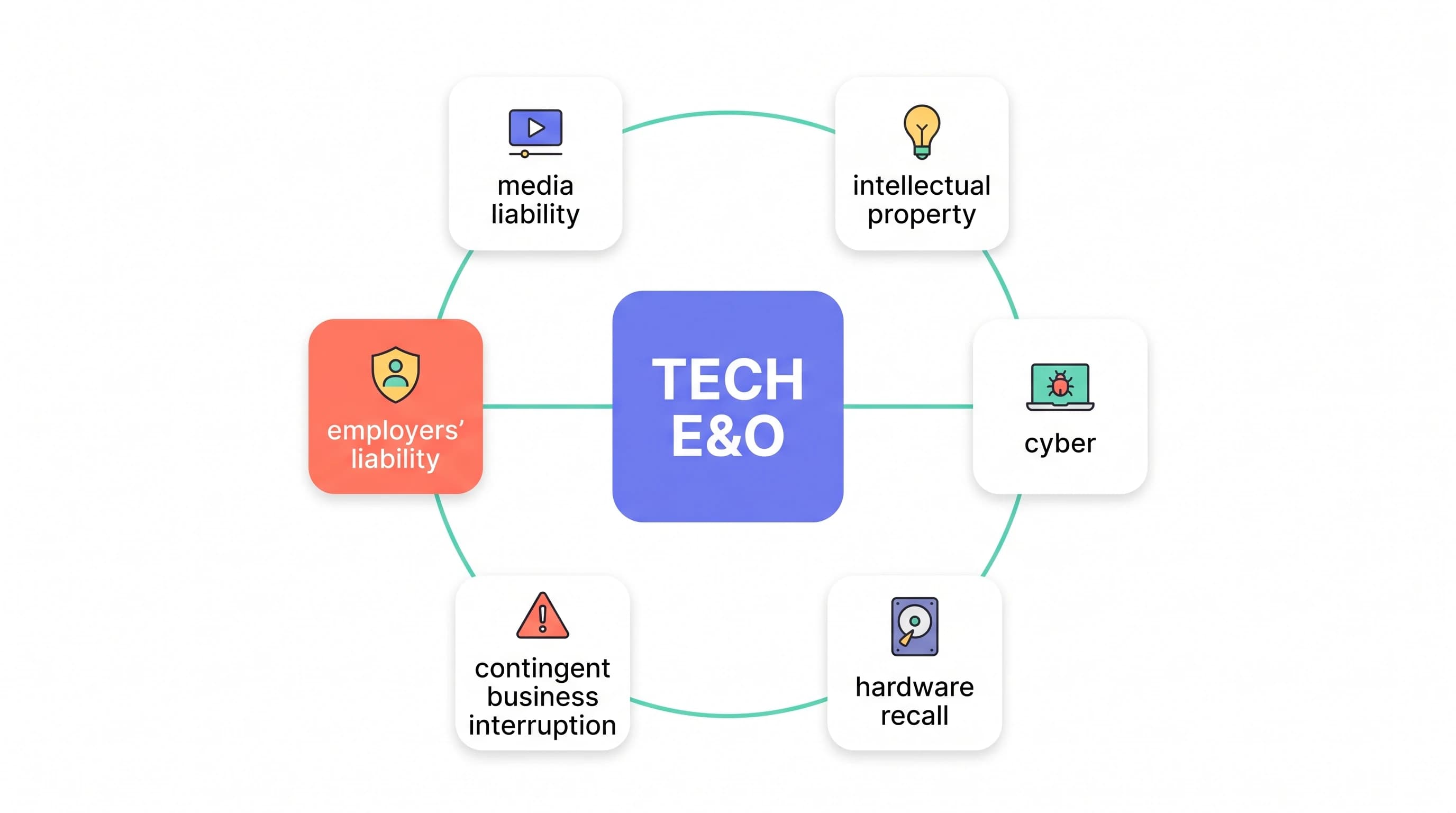
Cyprus law classifies these covers rather than compelling them. Your liability lines are class 13 general liability under Law 38(I)/2016, and loss-of-income cover is class 16. Those classes decide which insurers are authorised to write the cover. They say nothing about how your policy is packaged.
Packaging is where renewal gets decided. Technology, cyber and media sections are usually written on modular forms that combine into a single policy: one limit, one set of definitions, one notification. Buy them together and you remove the overlaps and close the gaps that appear when each section comes from a different insurer on a different form.
Servers, laptops and office equipment are physical damage rather than liability, so they sit on commercial property insurance in Cyprus. Ask for both at once and the two schedules can be lined up on the same renewal date.
What does technology company insurance cover in Cyprus?
It covers the financial loss a client suffers when your technology fails, plus content and defamation claims, defence of an intellectual-property infringement claim, cyber liability and incident response, hardware recall, and revenue lost to a supplier outage. Employers' liability sits alongside it and is the only part Cyprus law compels.
See what your build actually needs. Get a quoteWho it is for
Who this is for, and who belongs on another page
It comes down to one question. Does your company hold a financial-services licence, or does it sell technology to companies that do? Only the second is this page's buyer. If you build, host or supply the software, you are in the right place.
This is you
- Software house or independent software vendor
- SaaS provider
- IT consultancy or systems integrator
- Managed service provider
- Web and app development agency
- Hardware or IoT manufacturer and importer
- Data-centre and hosting provider
- iGaming platform, content or payment supplier
- Trading-platform technology vendor that holds no licence itself
Another page fits you better
- A CySEC-licensed investment firm
- A fund manager or alternative investment fund manager
- A licensed iGaming operator, which is your customer rather than you
- An electronic money or payment institution licensed by the Central Bank of Cyprus
A licensed firm buys a programme shaped by its licence conditions, and that is a different purchase. It is set out on insurance for CySEC-regulated firms, and this page stays with the technology company: no financial-services licence, and an exposure driven by customer contracts rather than by a regulator.
If you manage funds, start at fund manager insurance in Cyprus instead.
iGaming needs a paragraph of its own, because I keep meeting platform suppliers who have been told the operator's licence guarantee somehow reaches them too. Your customer's Class B online licence is secured with a €550,000 bank guarantee lodged with the National Betting Authority, plus €500,000 of issued and paid-up share capital. Neither of those is insurance, and neither reaches you as a supplier. If a platform failure costs the operator a weekend of revenue, that claim arrives through your supply contract.
The law
What Cyprus law actually requires of a technology company
Cyprus law does not require a technology company to carry technology E&O, cyber or professional indemnity cover. It does require employers' liability insurance from your first employee, at a minimum of €160,000 per employee under Law 174(I)/1989, and third-party motor cover for any company vehicle. Everything else on this page is driven by your customer contracts, not by statute.
Tech E&O, professional indemnity, cyber, media, intellectual property
Compulsory in Cyprus? · No. Not compulsory for a Cyprus technology company, which does not stop a customer contract demanding it
Authority · Not among the compulsory classes the Insurance Companies Control Service enumerates
Employers' liability
Compulsory in Cyprus? · Yes. From your first employee, at a minimum of €160,000 per employee
Authority · Law 174(I)/1989
Motor third-party
Compulsory in Cyprus? · Yes. For any company vehicle, at €38.6 million bodily injury and €1.3 million property damage
Authority · Law 96(I)/2000
Two founders and one hire is enough to trigger the second row. The detail sits on employers' liability insurance, and it is the one line on this page you can be fined for going without.
One narrow corner of the sector does carry a statutory duty, and it shows where the law stops. Article 24(2)(c) of Regulation (EU) No 910/2014 requires a qualified trust service provider to maintain sufficient financial resources and/or obtain appropriate liability insurance. Read the and/or: capital, insurance, or both will satisfy it. Cyprus's national trusted list, operated by the Department of Electronic Communications, listed exactly one qualified provider when we checked it in July 2026, JCC Payment Systems. Regulation (EU) 2024/1183 left the requirement in place.
NIS2 is the one people get wrong. Directive (EU) 2022/2555, carried into Cyprus law through Law 89(I)/2020, imposes cybersecurity risk-management duties. It requires you to manage the risk, not to insure it. Insurance is how you fund the loss NIS2 tells you to prepare for.
DORA has a similar shape. The ICT risk-management and third-party requirements in Regulation (EU) 2022/2554 do not require a technology supplier to carry insurance. The pressure arrives through your customers' contract terms instead: indemnities, liability caps, audit rights and exit clauses. That is why a bank or a licensed firm asks for a certificate your regulator never will.
Which leaves the sentence this whole page turns on. The liability is mandatory. The insurance is not. A Cyprus court will hold you to what you owe your customer whether or not anyone is funding it.
Is technology insurance mandatory in Cyprus?
No. Technology E&O, professional indemnity, cyber, media and intellectual-property cover are not compulsory for a Cyprus technology company. Employers' liability is, from your first employee, at a minimum of €160,000 per employee under Law 174(I)/1989, and third-party motor cover is compulsory for any company vehicle under Law 96(I)/2000.
Check what your contracts require. Get a quote9 December 2026
From 9 December 2026, your software is a product in law
Directive (EU) 2024/2853 brings standalone software, and the digital files used to manufacture things, inside the legal definition of a product in Article 4. It applies from 9 December 2026, and Cyprus's Law 105(I)/1995 continues to govern products placed on the market before that date. After the cut-off, a defective release can trigger strict liability instead of a contract argument.
Strict liability changes who has to prove what. The person claiming does not have to show you were careless. They show the product was defective and that the defect caused their damage. Directive 85/374/EEC has done that job for physical goods since 1985. Software is what is new.
Articles 9 and 10 then add rebuttable presumptions. In the circumstances the Directive lists, such as a failure to disclose evidence or a claim too technically complex for the claimant to prove, defectiveness or causation is taken as established and it falls to you to show otherwise. It is a presumption that bites in the listed situations, and that changes how a claim gets defended.
Two smaller changes matter to a software business. Article 6(1)(b) abolishes the €500 property-damage threshold, so modest claims stop being uneconomic to bring. And the compensable heads now include destruction of data that is not used for professional purposes, plus medically recognised psychological harm.
Cyprus has not tabled a bill transposing the Directive. The 9 December 2026 application date is fixed at EU level regardless, so plan around the Directive itself rather than around a Cyprus law number that does not exist yet.
Product safety and product liability get mixed up constantly, and they are separate regimes. Regulation (EU) 2023/988 and Cyprus's Law 116(I)/2025 govern what you may put on the market. Product liability is who pays after something goes wrong.
A Limassol SaaS firm ships a release in January 2027 that quietly corrupts a customer's records. Before the cut-off that is an argument about a limitation-of-liability clause. After it, the same defect can be pleaded as a defective product.
If you make or import hardware, the exposure is already live and it is covered on product liability insurance in Cyprus. From December 2026 the software side joins it.
Is a software company liable for a defective product in Cyprus?
Today the claim usually runs on contract, and Law 105(I)/1995 covers physical products. From 9 December 2026, Directive (EU) 2024/2853 treats standalone software as a product, so a defective release can bring strict liability. Law 105(I)/1995 still governs products placed on the market before that date.
Review your cover before 9 December 2026The spine
Technology E&O: cover for technology that fails
Technology E&O answers for the technology, not for the advice. A missed delivery date, a release that breaks a client's process, an integration that silently stopped writing data for four months: each is a performance failure, and each is what this section is bought for. The client's loss is money, not a broken window.
Claims-made cover and the retroactive date
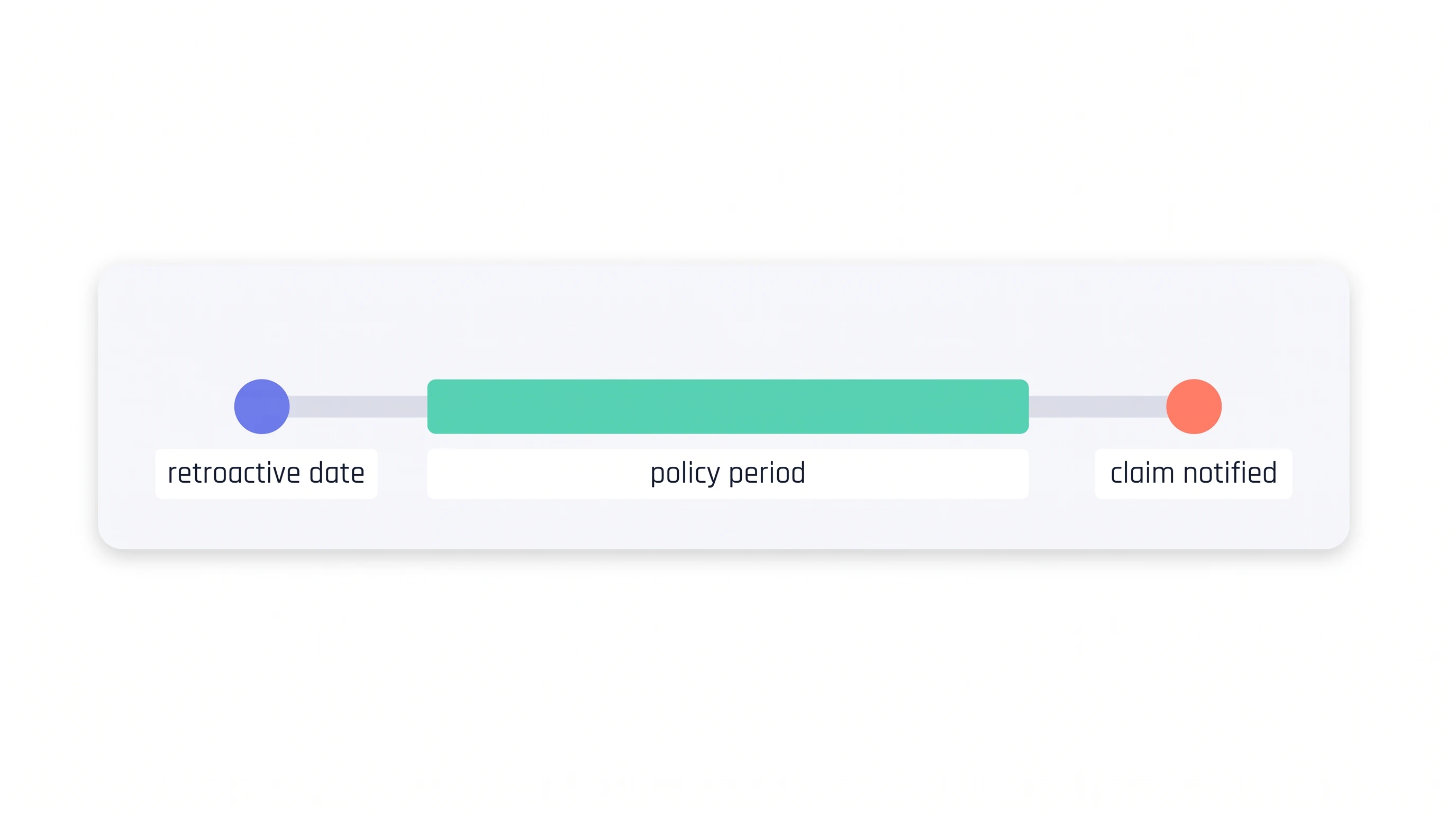
This cover is written on a claims-made basis, and that one term decides whether you get paid. The policy responds to the claim made against you during the policy period, not to the year you did the work. So the retroactive date matters: it sets how far back the work can go and still be covered. It is the first thing I look for on a policy somebody else placed, because a retroactive date set at inception writes off every project the company delivered before that day. A continuous-cover clause protects you when you change insurer, and notification of circumstances is the duty that keeps an early rumble alive as a claim later.
What your customer's contract is actually asking for
Enterprise contracts rarely stop at a limit. An additional insured endorsement extends your policy to name the customer. A waiver of subrogation stops your insurer recovering from them after it pays. When the customer is American, the clause to hunt for is worldwide coverage and jurisdiction, because the litigation is what makes US work expensive. And read the master services agreement next to the policy: your limitation-of-liability cap is only as good as its carve-outs, and service-level-agreement liquidated damages are commonly excluded or carved back.
Then the limit itself. €1 million to €5 million is the professional-indemnity range Cyprus technology firms are most often asked for, and the useful thing to know is where that number comes from: it is commercial, not legal. No Cyprus statute sets a limit of indemnity for a technology company. The figure comes from customer contracts, tenders and international partners. So the right limit is the one your largest contract names, not a number copied from a market summary.
The wording around that limit moves its value as much as the figure does. An aggregate limit is spent across the year, while an any-one-claim limit resets. And defence costs can sit inside the limit or outside it: a limit that pays your lawyers first is not the limit you thought you bought.
Advice, drawings and professional opinion are a different exposure, and they sit on professional indemnity insurance in Cyprus. Most technology firms need both, written on one form.
What is the difference between professional indemnity and tech E&O insurance?
Professional indemnity covers human advice and professional judgement. Technology E&O covers technology that fails to perform: a defect, a late delivery, an outage that costs the client money. A software house usually needs both, and on a combined form the two sections share one limit and one set of definitions.
Get your Tech E&O limit quotedContent and IP
Media liability and intellectual property
These two get bundled together and then bought without being read. Media liability deals with content. Intellectual property cover deals with rights. Both sit on the same form as Tech E&O, and both are usually sub-limited, so the number on the schedule is not the number you assume.
Media liability answers for what you publish: defamation and disparagement, copyright in published material, advertising injury and passing off, and the acts of the subcontractors and freelancers who produced it. The line against the spine cover is clean: this section covers what you published, while Technology E&O covers a product or service that failed.
Intellectual property splits in two, and only one half is routinely buyable in Cyprus. Infringement defence, where a third party claims you infringed their rights, is core to the programme. It is commonly sub-limited, and patent infringement is commonly excluded, so never assume patent cover is standard. Ask which rights the wording actually names.
Enforcement is the other half: you suing an infringer, plus title disputes, invalidity challenges and oppositions. A London specialty desk sells that. On a retail Cyprus programme it is rarely available, and it is a specialist placement when it is. If your business plan depends on enforcing a patent, say so early and we will look at it separately.
For an agency or a consultancy where the content is the deliverable, defamation and media cover is set out on professional indemnity insurance for consultants and freelancers.
Claims aimed at the founders personally are a separate cover again, on directors' and officers' liability insurance.
Cyber and data
Cyber, GDPR and where the cover stops
The cyber section has two halves. Third-party liability answers claims from people whose data was exposed. First-party response pays for forensics, restoration, extortion and notification. At claim time the split matters: cyber answers for data loss and attack, Technology E&O for performance failure.
The Digital Security Authority's 2025 survey of 459 Cyprus companies found 53% had suffered a cyberattack or breach in the previous 12 months, up from 47% the year before, with affected businesses losing an average of €12,000. Phishing remains the leading attack vector here.
Before you sign, ask about sub-limits. Cyber sections are usually written with ceilings that sit below the policy limit, so ransomware and network interruption can each carry their own. Get yours in writing.
Corporate cyber is not personal cyber. Identity-theft and retail-fraud cover is a consumer product for a household. This section is about a company's liability to its customers and the cost of its own incident.
Article 82 of Regulation (EU) 2016/679 creates a civil right to compensation, and that is the liability a policy can answer for, together with the cost of defending and investigating a breach. Article 83 creates administrative fines, supervised in Cyprus by the Office of the Commissioner for Personal Data Protection under Law 125(I)/2018. Whether a Cyprus administrative fine could be insured has never been settled by a Cyprus court, so we do not sell cover for one.
There is a mechanism that would decide it: section 23 of the Contract Law, Cap. 149, makes an agreement void where its object is unlawful, on five independent limbs. Forbidden by law. Of such a nature that, if permitted, it would defeat the provisions of any law. Fraudulent. Involving injury to the person or property of another. Or the Court regards it as immoral or opposed to public policy. Any question about insuring a penalty in Cyprus passes through it.
Cyber bought on its own is on cyber insurance in Cyprus. Here it is one section of a bigger form.
Does technology insurance cover a data breach, or do I need cyber insurance?
You need the cyber section, usually written into the same policy. Technology E&O answers for a performance failure. Cyber answers for the breach itself: third-party claims from people whose data was exposed, plus forensics, restoration, extortion and notification.
Get cyber and Tech E&O quoted togetherHardware and dependency
Hardware recall and dependency on someone else's platform
Most Cyprus technology programmes arrive missing the same pair of covers. One pays to take a defective device off the market. The other pays when your revenue drops because someone else's system went down.
Product recall, hardware only
Say hardware every time here, because recall is not available for pure software. It funds the withdrawal of a defective device once you or a regulator decides it has to come off the market. For an importer, this cover and the December 2026 change belong in the same conversation.
What a recall actually pays for
Withdrawal, replacement or destruction of the affected units
Logistics, storage and disposal
Regulatory and government-ordered recall costs
Crisis communication and rebuilding the brand afterwards
Component-part cover, for your part triggering a recall of someone else's finished product
Component-part cover is the item Cyprus module and component suppliers under-buy, and in my experience nobody asks about it until a customer's recall clause turns up in a supply contract. Your board goes into another manufacturer's product, the finished product gets recalled, and the cost lands on you rather than on the brand whose name is on the box.
Contingent business interruption
Contingent business interruption covers your revenue loss caused by someone else's outage: a cloud provider, a hosting company, an upstream API, a supplier or a utility. Cyprus files loss-of-income cover as class 16. Whether it pays comes down to the timings. The waiting period, because a short outage can fall entirely inside it. And the indemnity period, which you choose rather than receive, and which is written in months rather than days.
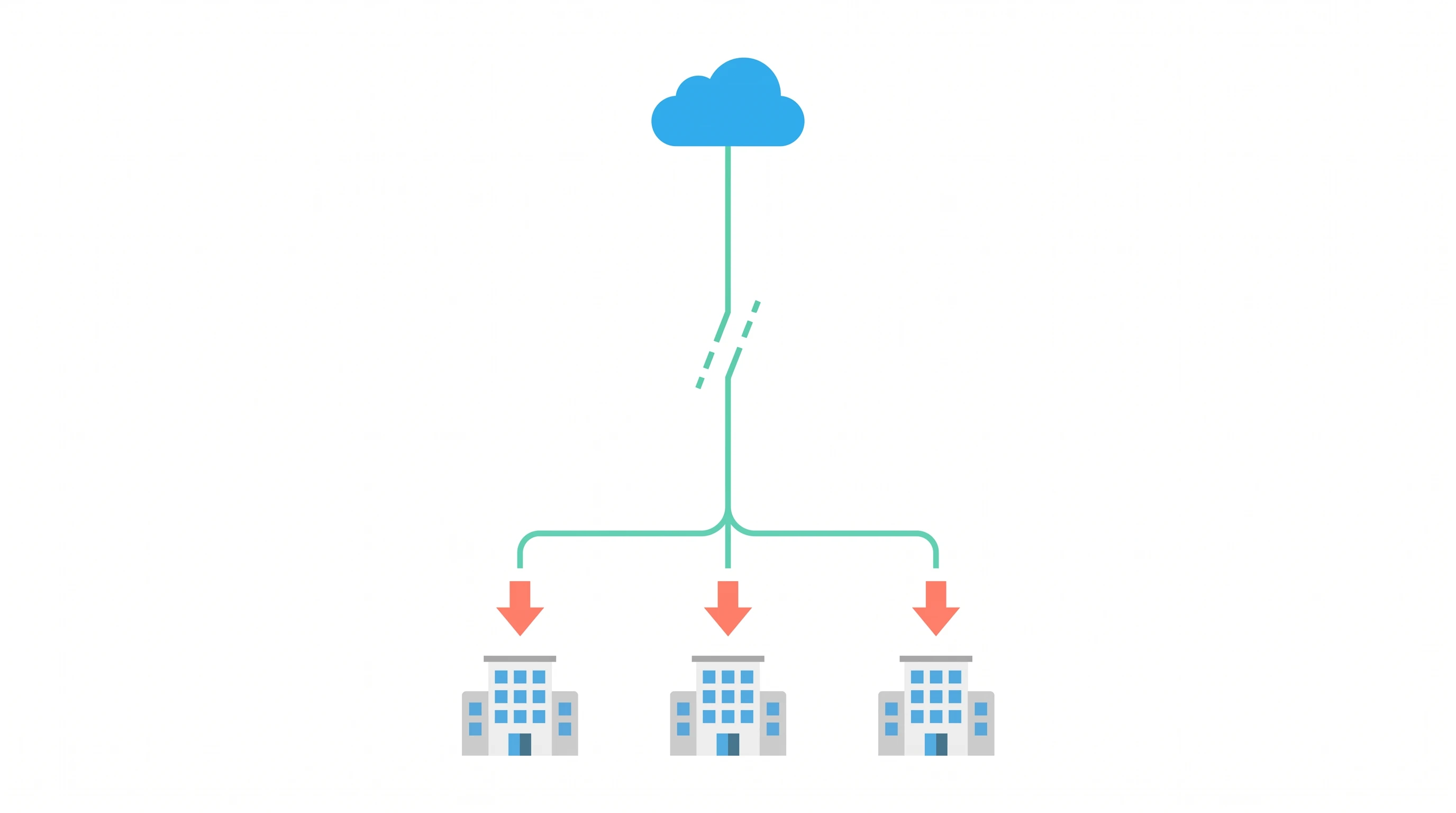
Interruption to your own operation, from fire or damage rather than from a supplier, is on business interruption insurance in Cyprus. The two are written on the same class and often on the same schedule.
Pricing
What it costs in Cyprus, and how premiums are rated
Cyprus technology premiums are quoted, not listed, and it is fairer to say so than to publish a number that will not survive your proposal form. The book is small and every risk in it is different, so no insurer surfacing on the Cyprus results publishes a rate table for it. What we can show you is exactly what moves the price.
What the premium is rated on
| Rating factor | Why it moves the premium |
|---|---|
| Annual turnoverPrimary rating base | The primary rating base. The market bands on it, and small digital businesses sit in the lowest bands |
| The activities you actually perform | Custom development, hosting and payment handling carry different exposures from resale or support |
| Where your customers are | US and UK customers cost more because the litigation does |
| The limit and basis your contract demands | Aggregate or any-one-claim, and whether defence costs sit inside the limit |
| Claims and circumstances history | Five years of it, including matters notified but never paid |
| Security posture | Multi-factor authentication, backups and patching evidence change the cyber section's terms |
About that last row. A SOC 2 or ISO 27001 report is evidence that helps your rating and sometimes your excess. It is not insurance, though, and no underwriter treats it as a substitute for cover.
Most of the numbers circulating on this query do not price a Cyprus risk. The dollar-a-month ranges come from US carriers, and the pound-a-month teasers from British ones. Different litigation environment, different limits, and not even the same currency. And if a search for private insurance in Cyprus brought you here, that phrase usually returns health cover, which is a different product entirely.
The one premium calculator ranking on this query runs on a German provider's rates from January 2024 and says on its own page that the result is not an offer. It does confirm that the cover is rated on turnover bands. As a Cyprus price it is worth nothing.
So we do it the slow way, which is also the honest one. You complete a proposal form, we put the risk to the insurers who write technology liability for Cyprus companies, and you get a written comparison with the Insurance Product Information Document (IPID) and the policy schedule attached. You see the limits, the sub-limits and the excess before you buy, not after.
How much does technology insurance cost in Cyprus?
There is no published Cyprus rate table for this cover, so it is individually quoted. Premiums are rated on annual turnover, the activities you perform, where your customers are, the limit and basis your contract demands, your claims history and your security posture. Send us those six things and you get a written comparison back.
Get My QuoteGet a quote
Talk to a licensed Cyprus insurance agent
Send us the shape of the business and the limit your contract names. We come back with a comparison across the insurers who write technology liability for Cyprus companies, with the wording checked, not just the price.
Tell us what you build
Your sector, your turnover band, your headcount and the limit your largest customer contract names. No phone call needed.
We compare the market
We check the retroactive date, the sub-limits and whether defence costs sit inside the limit, across 10+ insurers.
You get it in writing
A written comparison with the Insurance Product Information Document and the policy schedule, plus a certificate of insurance once you bind.
The form asks for your company name, how to reach you, your sector, your annual turnover band, your headcount, the limit your customer contract requires, and the territories you sell into.
A written comparison comes back usually within two working days. If a customer is holding a signature until they see a certificate of insurance, tell us the date.
Tell us what you build
Eight fields. We reply with a comparison across the insurers who write technology liability for Cyprus companies.
DigiCare Insurance is a licensed Cyprus insurance agency, ICCS licence 2451, with 15+ years in Cyprus since 2009 and 5.0 on Google. We compare 10+ insurers and work in English, Greek and Russian, with technology clients in Limassol and Nicosia.
This programme sits inside business insurance in Cyprus. Cyber insurance and professional indemnity insurance are usually written on the same schedule.
Primary sources for the legal statements on this page
- Directive (EU) 2024/2853 on liability for defective products, Articles 4, 6, 9 and 10 (EUR-Lex)
- International Bar Association: Liability for software under the new European Product Liability Directive
- Regulation (EU) No 910/2014 (eIDAS), Article 24(2)(c) (EUR-Lex)
- Cyprus National Trusted List of qualified trust service providers, Department of Electronic Communications
- Employers' Liability (Compulsory Insurance) Law 174(I)/1989 (Insurance Companies Control Service)
- Contract Law, Cap. 149, section 23, official 1959 statute book (Sovereign Base Areas Administration)
- Contract Law, ΚΕΦ.149, consolidated Greek text (cylaw.org)
- National Betting Authority: licence prerequisites, frequently asked questions
- Office of the Commissioner for Personal Data Protection, Cyprus
- Cyprus Mail, 25 February 2026: One in three Cyprus citizens, half of businesses hit by cyberattacks (Digital Security Authority survey)
Costas Matheou — Licensed insurance agent, DigiCare Insurance, Paphos, Cyprus
Last reviewed: 30 July 2026
Licensed Cyprus insurance agency · ICCS licence 2451
We review this page whenever an EU instrument or a Cyprus law changes what a technology company owes its customers, and again before Directive (EU) 2024/2853 applies on 9 December 2026.
FAQ
Frequently asked questions
Software becomes a product in law on 9 December 2026
Your contracts already name a limit and your customers already ask for a certificate. Send us the turnover, the sector and the limit, and we will compare the technology programme across 10+ insurers before the Directive applies.
Licensed Cyprus insurance agency, ICCS licence 2451 | 5.0 on Google