
- >
- Blog >
- How Much Does Healthcare Cost in Cyprus? 50+ Prices and Statistics (2026)
How Much Does Healthcare Cost in Cyprus? 50+ Prices and Statistics (2026)


EUR 150
Annual GeSY cap
maximum out-of-pocket per year (HIO, 2026)
EUR 1
Prescription cost
per item under GeSY (HIO, 2026)
EUR 6
Referred specialist
with GP referral under GeSY (GOV.UK, 2026)
EUR 40-150
Private GP visit
depending on clinic and city (Cyprus clinic data, 2026)
83.2 yrs
Life expectancy
1.6 years above EU average (OECD/EC, 2025)
1M+
GeSY beneficiaries
over 90% of the population (HIO, 2026)
"How much does healthcare cost in Cyprus?" is usually the first thing people ask us before moving here, retiring here, or booking a holiday. The answer tends to settle nerves. Healthcare in Cyprus is not entirely free, but it is among the most affordable in Europe. Under the public General Healthcare System (GeSY), residents pay small fixed co-payments at the point of care, and total out-of-pocket spending is capped at EUR 150 a year (Health Insurance Organisation, 2026). Going private costs more, from EUR 40 to EUR 150 for a GP visit, but still less than the UK or northern Europe.
This guide breaks down what healthcare in Cyprus actually costs in 2026: GeSY co-payments, private clinic prices, dental fees, what tourists pay, and how Cyprus stacks up against the rest of the EU. DigiCare Insurance has advised Cyprus residents for over 15 years, so the figures below are the ones people genuinely pay, not list prices nobody honours.
Is healthcare free in Cyprus in 2026?
There are two cost layers. The first is what you pay before you ever see a doctor. Workers, employers, pensioners and the state all pay a percentage of income into GeSY each month. You never see this at the clinic, but it is what keeps the system running.
The second is what you pay at the counter. Visit a GP, see a specialist or pick up a prescription, and you hand over a small fixed co-payment. The UK government confirms that state healthcare in Cyprus is not free (GOV.UK, 2026), though the amounts are low by European standards.
So the honest answer is: almost, if you contribute. You pay in through tax, pay small amounts when you use it, and those amounts stop once you hit the annual cap. The next section spells out exactly how much each group contributes.
How Cyprus healthcare is funded: GeSY contribution rates in 2026
GeSY runs on mandatory contributions split across six payer groups, each charged as a percentage of income. The Health Insurance Organisation handles the financing, the Ministry of Health regulates the system, and public hospitals are run by the State Health Services Organisation (SHSO, known locally as OKYpY).
The system arrived in two phases: outpatient care from June 2019 and inpatient care from June 2020 (Wikipedia, 2025). Rates went up once during the rollout, then settled. They have not changed since 1 March 2020.
GeSY contribution rates (current, from 1 March 2020)
| Payer group | Contribution rate |
|---|---|
| Employees | 2.65% |
| Employers | 2.90% |
| Self-employed | 4.00% |
| Pensioners | 2.65% |
| Income earners (rent, dividends, interest) | 2.65% |
| The state | 4.70% |
Contributions are charged on income up to a ceiling of EUR 180,000 a year. Source: Health Insurance Organisation (gesy.org.cy), 2026.
During the launch phase (1 March 2019 to 29 February 2020), rates sat lower while the system found its feet:
GeSY launch-phase contribution rates (2019 to 2020)
| Payer group | Launch-phase rate |
|---|---|
| Employees | 1.70% |
| Employers | 1.85% |
| Self-employed | 2.55% |
| Pensioners | 1.70% |
| The state | 1.65% |
GeSY covers Cypriot citizens, EU workers, residence-permit holders and their dependants. Non-EU permanent residents become eligible after 12 months of legal residence (Demetriades Law, 2026) under Category F or Regulation 6(2). This is the money you pay before you ever sit in a waiting room. More than 1 million people are now registered with GeSY, over 90% of the population, according to the Health Insurance Organisation (2026).
GeSY co-payments in 2026: the full price list
Here is the full 2026 GeSY co-payment price list. These are the amounts a registered beneficiary pays at the point of care.
GeSY co-payment price list 2026
| Service | GeSY co-payment |
|---|---|
| GP (personal doctor) visit | Free up to an age-based annual allowance, then up to EUR 15 |
| Specialist with GP referral | EUR 6 |
| Specialist without referral | EUR 25 |
| Accident and Emergency (A&E) visit | EUR 10 |
| Prescription medicine | EUR 1 per item |
| Laboratory test | EUR 1 per test (max EUR 10 per category) |
| X-ray | typically EUR 6 to EUR 10 |
| Dental | 1 preventive check-up and clean per year |
| Ambulance | Free for beneficiaries |
| Annual personal cap | EUR 150 (EUR 75 reduced) |
Source: Health Insurance Organisation (gesy.org.cy) and GOV.UK guidance on healthcare in Cyprus, 2026.
The core figures here are government-verified. The UK government lists the EUR 1 prescription, EUR 6 referred specialist, EUR 25 unreferred specialist and EUR 10 A&E co-payments (GOV.UK, 2026), and the Health Insurance Organisation confirms the EUR 1-per-test lab fee capped at EUR 10 per category (Health Insurance Organisation, 2026). Ambulance transport is free for beneficiaries for emergencies and medically necessary transfers.
GP visits are free up to an annual allowance set by your age, with younger children and older adults getting more free visits. After that, a visit costs up to EUR 15. A medical card lowers or zeros these co-payments (GOV.UK, 2026) for eligible low-income groups.
How much does private healthcare cost in Cyprus?
Published price figures vary from one source to the next, so the table below settles them into conservative ranges and puts the same service side by side under GeSY and privately.
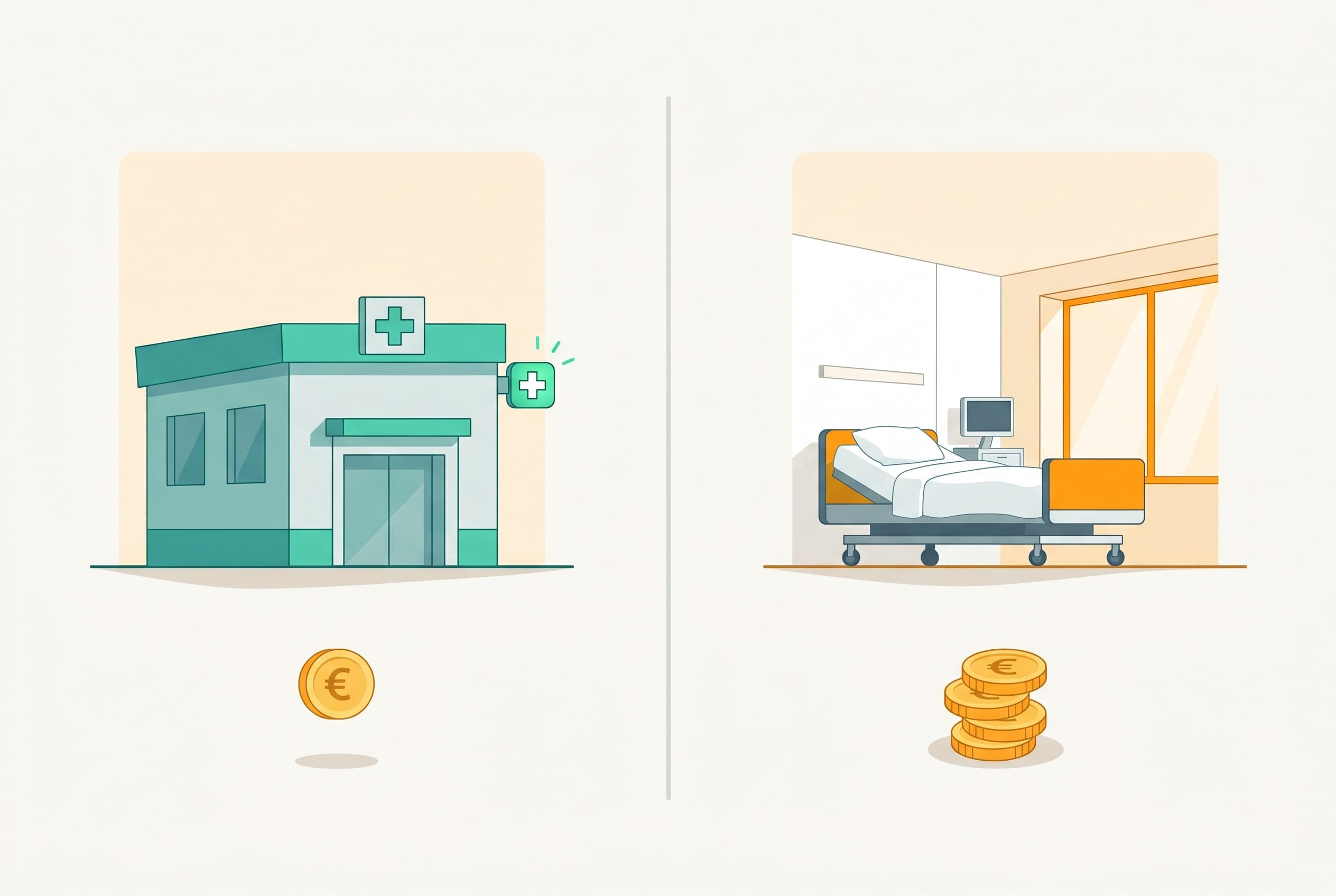
Public GeSY vs private healthcare costs in Cyprus 2026
| Service | Private cost | GeSY co-payment |
|---|---|---|
| GP / doctor visit | EUR 40 to EUR 150 | Free or up to EUR 15 |
| Specialist consultation | EUR 80 to EUR 300 | EUR 6 (referred) / EUR 25 (unreferred) |
| A&E / emergency room | typically EUR 150 to EUR 500 | EUR 10 |
| Inpatient stay (per day) | EUR 400 to EUR 5,000 | Covered |
| MRI scan | typically EUR 250 to EUR 350 | Covered with referral |
| Blood panel | typically EUR 60 to EUR 150 | EUR 1 per test (max EUR 10) |
| Diagnostics package | typically EUR 300 to EUR 800 | Covered with referral |
| Common surgery | typically EUR 2,000 to EUR 5,000 | Covered |
Source: published Cyprus clinic price lists and agency data, DigiCare Insurance, 2026.
Most private hospitals and clinics in Cyprus charge within these ranges. The spread comes down to where you are (Limassol and Nicosia tend to run higher than smaller towns), the hospital itself, how complex the procedure is, and whether you pay out of pocket or through insurance. Why do people go private when GeSY is so cheap? Usually for speed, for an English-speaking doctor, and for the freedom to pick their own hospital and consultant.
For published private prices, the University of Nicosia Medical Centre lists a specialist consultation at EUR 50 to EUR 75, an ECG at EUR 30 and an echocardiogram at EUR 120 (University of Nicosia Medical Centre, 2026). A standalone MRI scan typically costs around EUR 250 to EUR 350 (123.clinic, 2026), and a standard private blood panel typically runs EUR 60 to EUR 150.
How much does a dentist cost in Cyprus?
Most dental work in Cyprus comes out of your own pocket, because GeSY only covers basic prevention. Here are the typical private prices.
Private dental prices in Cyprus 2026
| Treatment | Typical private cost |
|---|---|
| Check-up / examination | EUR 40 to EUR 60 |
| Cleaning | around EUR 60 |
| Filling | EUR 60 to EUR 80 |
| Crown | EUR 350 to EUR 500 |
| Implant (per implant) | EUR 500 to EUR 910 |
| Teeth whitening | EUR 350 to EUR 600 |
Source: published Cyprus clinic price lists (Tsitsis Dental Clinic, Bookimed, 2026).
These ranges come from published Cyprus clinic price lists. A Limassol clinic lists a filling at EUR 60 to EUR 80, a metal-ceramic crown from EUR 350 and whitening from EUR 350 (Tsitsis Dental Clinic, 2026). Implant pricing is confirmed across two sources, with a single implant ranging from EUR 500 to EUR 910 (Bookimed, 2026).
Under GeSY, dental cover stops at one preventive check-up and clean per year (Comark Estates, 2025). Everything past that you pay for yourself.
Cyprus dental prices run up to around 70% cheaper than the UK, where implants commonly cost GBP 1,500 to GBP 4,000. English-speaking dentists, EU clinical standards and low fees are enough to bring patients over from Britain and elsewhere purely for the dental work.
Healthcare costs for tourists and visitors in Cyprus
If you are visiting Cyprus, your costs hinge on what you bring with you. EU residents with a valid EHIC and UK residents with a GHIC get medically necessary state care (GOV.UK, 2026) at the same rates as locals. Neither card covers private treatment or repatriation, so travel insurance still earns its place in your booking.
Visitors without a card pay upfront and claim the money back afterwards. Schengen visa holders need travel insurance covering at least EUR 30,000 in medical expenses plus repatriation, which is the standard Schengen requirement. The travel insurance itself typically costs EUR 20 to EUR 250 per trip, or roughly EUR 45 per person per week.
Practical numbers for visitors:
- Private GP visit: EUR 40 to EUR 100
- Private A&E / emergency room: EUR 150 to EUR 500
- Prescription medicine (private): EUR 5 to EUR 50
Pharmacies deal with minor ailments and dispense many medicines without a prescription. In an emergency, call 112 or the local ambulance line 199. For non-emergency health advice, the nurse line is 1400. Routine care for tourists stays cheap, and a serious emergency gets stabilised whether or not you are covered.
Expats, UK pensioners and the S1 form: who pays what
Residents reach Cyprus healthcare by different routes, and what they pay depends on that route. Here is the breakdown.
- UK State Pensioners (S1 form): register an S1 to access GeSY on the same basis as a Cypriot (GOV.UK, 2026). The UK funds their care, so they pay no extra Cyprus contribution, just the standard GeSY co-payments.
- Working expats: pay GeSY contributions through payroll like any employee or self-employed person, then pay normal co-payments at the point of care.
- Non-EU permanent residents: become eligible for GeSY after 12 months of legal residence under Category F or Regulation 6(2) (Demetriades Law, 2026).
- Medical card holders: low-income groups who qualify for a medical card pay reduced or zero co-payments.
For non-EU newcomers who are not yet GeSY-eligible, immigration medical insurance covers that first year of residence until GeSY kicks in. We walk through it in our guide to health insurance for expats in Cyprus. The takeaway is simple: however they arrived, most settled residents end up paying the same low GeSY co-payments, capped at EUR 150 a year.
Does private health insurance lower your healthcare costs in Cyprus?
Your GeSY co-payments stay exactly the same whether or not you hold private cover. Private insurance sits on top, paying for the private track: faster specialist access, private rooms, your own choice of consultant. So when clients ask us whether private cover will "save them money," the honest answer is that it buys time and comfort, not a lower bill at the public counter.
To weigh up the public and private routes, read GeSY vs private health insurance, look through the private health insurance options on our pillar page, or get a private health insurance quote for figures matched to your situation.
The takeaway: insurance is the lever for speed and choice, not for shrinking the EUR 1 prescription or EUR 6 specialist co-payment. Those are already among the lowest in Europe.
Compare GeSY and private cover and find the right health plan for your life in Cyprus.
Compare Health Insurance Plans in CyprusIs Cyprus healthcare good value? The data verdict
The numbers below come from the OECD and European Commission Cyprus Country Health Profile, which uses 2023 and 2024 data.
Cyprus vs EU average health indicators (2023-2024)
| Indicator | Cyprus | EU average |
|---|---|---|
| Health spending (% of GDP) | 8.1% | 10.0% |
| Per-capita spending (PPP) | EUR 2,795 | EUR 3,832 |
| Doctors per 1,000 | 5.2 | 4.3 |
| Hospital beds per 1,000 | 3.1 | 5.1 |
| Nurses per 1,000 | 5.3 | 8.5 |
| Life expectancy (years) | 83.2 | 81.7 |
| Self-reported good health | 75% | 68% |
Source: OECD/European Commission Cyprus Country Health Profile 2025 (eurohealthobservatory.who.int).
Cyprus spends 8.1% of GDP on health against the EU's 10.0% (OECD/European Commission, 2025), and per-capita spending of EUR 2,795 PPP sits below the EU's EUR 3,832. Despite spending less, Cyprus has more doctors per head (5.2 vs 4.3) and a life expectancy of 83.2 years, 1.6 years above the EU average.
GeSY has changed who carries the cost. Out-of-pocket spending fell from around 44% before GeSY to 18% by 2023, while the public funding share climbed from 42% in 2018 to 77% in 2023. On the Lancet Healthcare Access and Quality Index, Cyprus scored 90.3, ahead of Israel and among the largest improvers worldwide since 1990. Death rates from preventable causes are among the lowest in the EU.
Key Takeaways
- Healthcare in Cyprus is not free, but GeSY co-payments are small and capped at EUR 150 a year (EUR 75 for low-income groups).
- A prescription costs EUR 1, a referred specialist EUR 6, A&E EUR 10, and a GP visit is free up to an age-based allowance then up to EUR 15.
- GeSY is funded by income-based contributions: 2.65% for employees, 2.90% for employers, 4.00% for the self-employed, charged up to EUR 180,000 of income.
- Private care costs more: EUR 40 to EUR 150 for a GP, EUR 80 to EUR 300 for a specialist, and EUR 400 to EUR 5,000 a day for an inpatient stay.
- Dental is mostly private, with implants from EUR 500 to EUR 910, up to around 70% cheaper than the UK.
- Tourists with an EHIC or GHIC get state-priced care; others pay upfront and claim via travel insurance covering at least EUR 30,000.
- Cyprus spends 8.1% of GDP on health yet beats the EU on life expectancy (83.2 years) and doctor density, making it strong value.
Methodology
This guide was compiled in June 2026 by DigiCare Insurance, a Cyprus insurance agency with 15+ years advising residents and expats. Co-payment and contribution figures come from the Health Insurance Organisation (gesy.org.cy) and the UK government (GOV.UK). Macro statistics are drawn from the OECD and European Commission Cyprus Country Health Profile 2025 and the Lancet Global Burden of Disease study. Private prices come from named Cyprus clinic price lists. Figures were cross-checked against two or more sources where possible; single-source figures are phrased as "typically." This guide is reviewed quarterly.
Frequently Asked Questions
Bottom Line: Cyprus Healthcare Costs in 2026
Healthcare in Cyprus is genuinely affordable by European standards. The GeSY public system gives residents small fixed co-payments capped at EUR 150 a year, funding it through income-based payroll contributions. Private care is available and notably cheaper than the UK or northern Europe, though more expensive than the public track.
Whether you are moving here, already resident, or planning a visit, the cost picture is clear: routine healthcare is cheap, emergency care is accessible, and dental is best handled privately. Private health insurance is the tool for speed and choice, not for reducing co-payments that are already among Europe's lowest.
Last updated: June 2026 by Paul Bendzik, DigiCare Insurance.
Compare GeSY and private health insurance options for Cyprus residents and expats.
Get a Free Health Insurance QuoteCompare GeSY and private cover and find the right health plan for your life in Cyprus.
Get a Free Quote