
- >
- Blog >
- Pink Slip Cyprus 2026: The Requirements CRMD Actually Publishes
Pink Slip Cyprus 2026: The Requirements CRMD Actually Publishes


€24,000
Income test, one person
Plus 20% for a spouse, 15% per child
CRMD supporting-documents checklist, gov.cy, 2026
€140
Government fees, year one
€70 application plus €70 first registration
CRMD, Visitors and family members, gov.cy, 2026
4 months
CRMD's published target
Advisers report about six in practice
CRMD visitor-permit page, gov.cy, 2026
90 days
Maximum unbroken absence
Commonly reported; longer can cancel the permit
Immigration adviser consensus, 2026
In Cyprus, a non-EU national who wants to stay longer than 90 days needs a temporary residence permit. Almost everyone on the island calls it the Pink Slip.
Go looking for the rules and you get a mess. Published income figures run from €10,000 to €24,000. Published waiting times run from four months to a year. And two of the pages ranking today still print an application form number that the Migration Department does not use anywhere on its site.
So this guide works from the source. Every figure below comes from the Civil Registry and Migration Department's own checklist, fees block or forms page, and each one is linked so you can check it yourself. Where the government publishes nothing, we say so and name the advisers reporting the number instead.
DigiCare Insurance is a licensed Cyprus insurance agency, ICCS licence 2451, and we place the Plan A medical cover this permit requires. That is why the certificate section below runs to a full specification rather than a one-line mention.
What is the Cyprus Pink Slip?
In Cyprus the phrase means a residence permit and nothing else. Elsewhere it can mean a US car title or a notice of dismissal, and some readers arrive here after a refused visa interview braced for bad news. None of that applies.
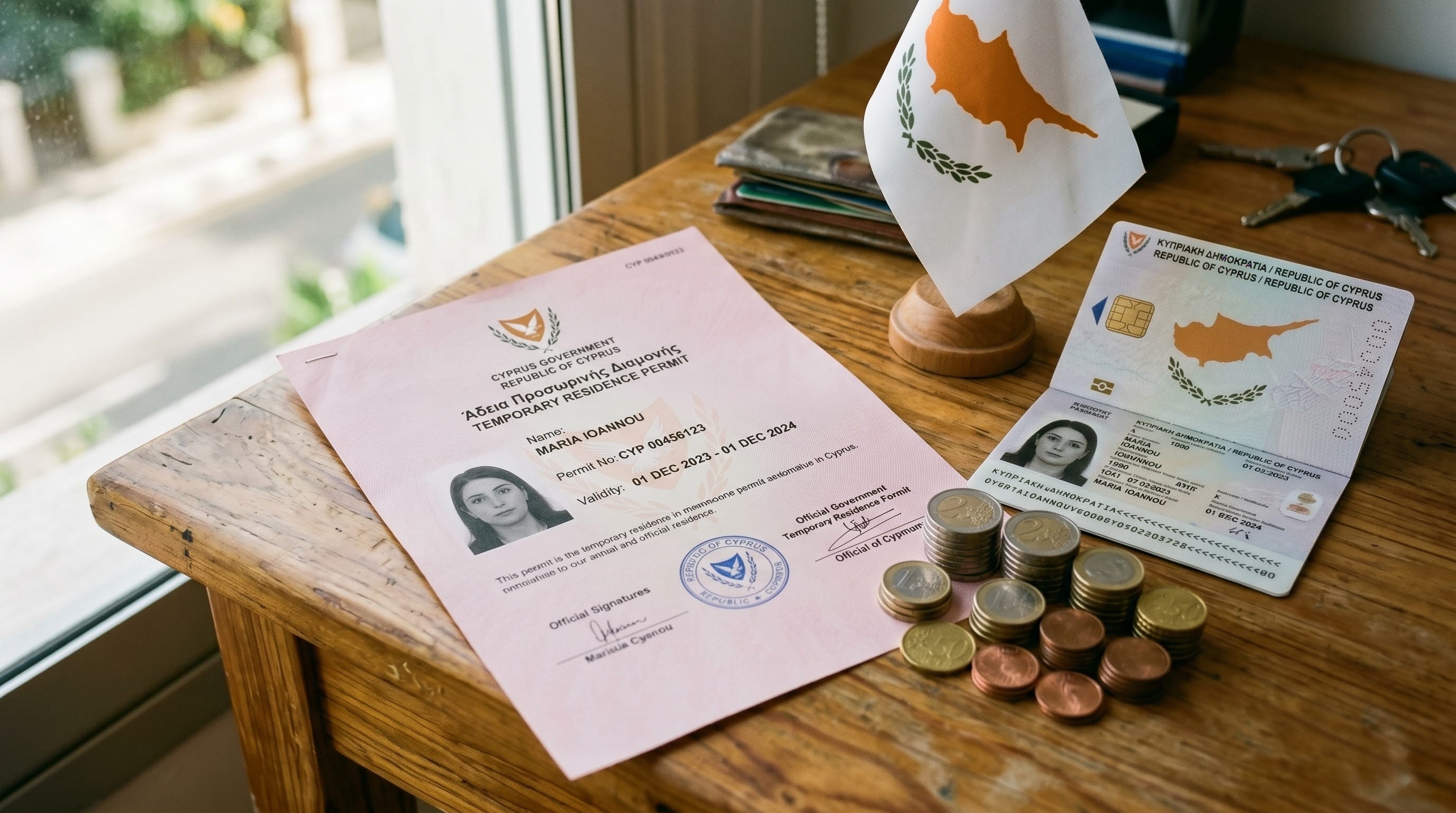
Pink Slip, Pink Card and TRC card are informal names for one official document: the temporary residence permit, registered with an Alien Registration Card (ARC). The name comes from the colour of the original paper slip, which stopped being pink years ago.
Worth correcting early, because it shapes what you search for. “TRC” is adviser shorthand, not the government's word. Neither of the Civil Registry and Migration Department's visitor pages, nor the Ministry of Interior residence-cards page, uses “Temporary Residence Card” or “TRC” anywhere. gov.cy says “residence permit” (Άδεια Διαμονής) and “Alien Registration Card (ARC)” (Δελτίο Εγγραφής Αλλοδαπού).
Three things get confused constantly, so separate them now:
- The permit is the decision. CRMD grants it, and it makes your stay lawful for a year.
- The submission receipt is the paper handed to you at the counter on filing day, and it is your proof of lawful stay while the file is open.
- The card is the plastic. It is printed after approval and can arrive months later.
Most of the worry in Cyprus expat forums comes from treating those three as one.
Who Can Apply for a Cyprus Pink Slip?
| Pink Slip | Yellow Slip (MEU1) | |
|---|---|---|
| Who it is for | Non-EU, third-country nationals | EU, EEA and Swiss citizens |
| What it is | Temporary residence permit | Registration certificate |
| Validity | One year, renewed annually | Open-ended; five years for non-EU family members |
| Right to work | No | Yes |
| Government fee | €70 plus €70 first registration | €20 |
| Income test | Yes, income earned outside Cyprus | Sufficient resources, no published threshold |
Sources: CRMD, Visitors and family members; Ministry of Interior, Residence cards. Accessed 11 September 2026.
A spouse and children under 18 go on one family file and are processed together. Each person still files their own MVIS8, and family members also appear in Part II of the main applicant's form.
Students at a Cyprus university or college take a student residence permit rather than a visitor Pink Slip. The institution normally files it for them.
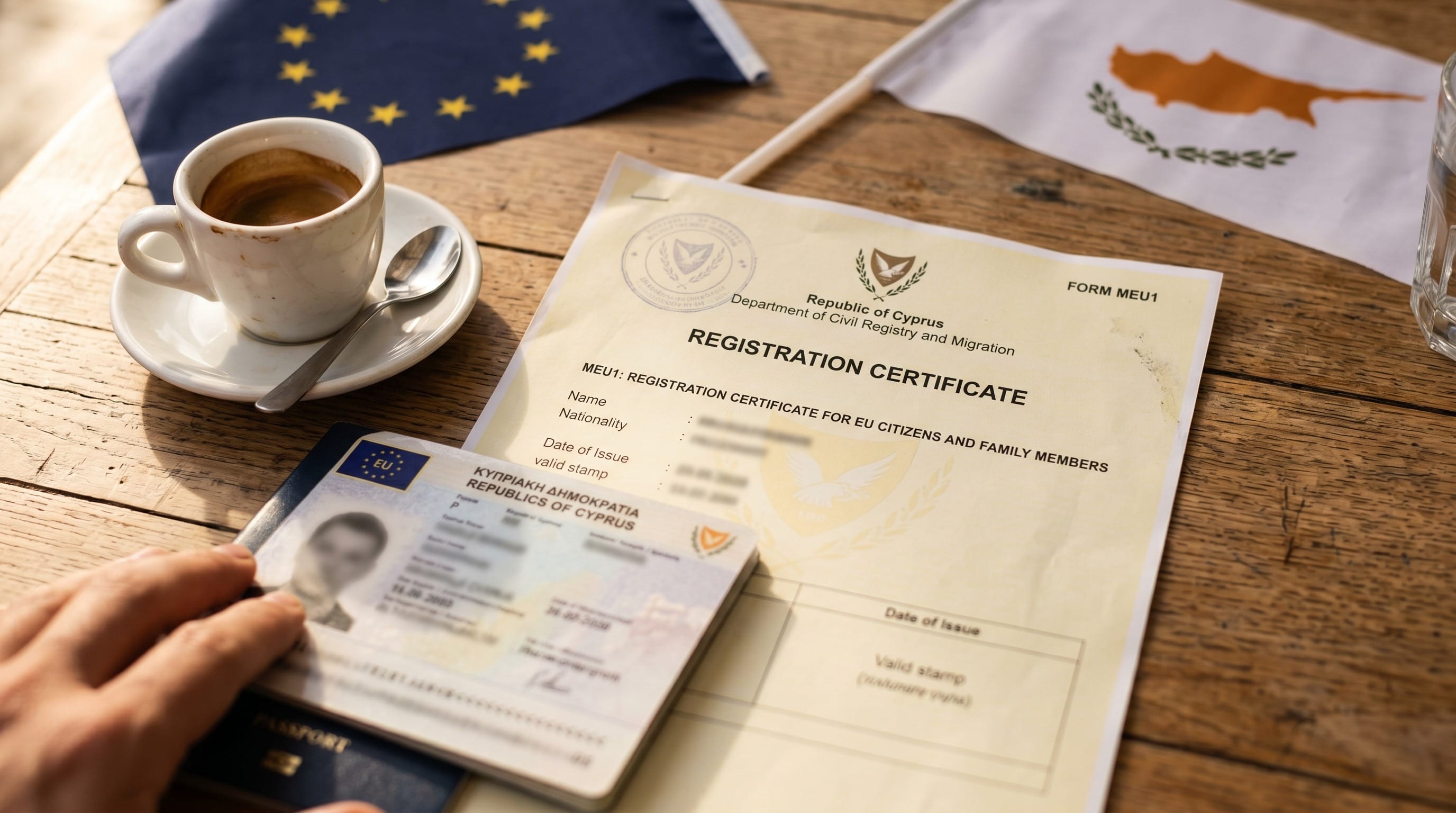
If you hold a yellow-slip document rather than a Pink Slip, the rules diverge from here on. Start with our Yellow Slip (MEU1) guide for EU citizens, or see how the health insurance requirement differs between the two.
How Much Income and Money Do I Need for a Pink Slip?

The figure is not adviser folklore. It sits in the Migration Department's official supporting-documents checklist for the visitor permit, hosted on gov.cy and linked from the Department's own Visitors (Forms) page. It asks for a Cyprus bank statement showing foreign remittances in your own name “which in total should not it is less than €2,000 per month or €24,000 per year for one person. This amount increases by 20% for the spouse and by 15% for each child.” Almost every page on this topic quotes that number, and as of 11 September 2026 none of them points at a government source for it.
The number matters less than what it measures. The test is money that actually arrived in Cyprus, in your name, over the last twelve months, not what your payslip says you earn. And the checklist carries one line that guides tend to leave out: “transfers abroad or to third parties will not be taken into account.” Money that lands and leaves again does not count.
The euro figures people quote at each other in forums are not competing versions of one rule. They are three separate pots.
| Pot | What it tests | Figure | Note |
|---|---|---|---|
| Foreign remittances into your Cyprus account | Money arriving from abroad, in your name | €2,000 a month or €24,000 a year, plus 20% spouse, 15% per child | Transfers out, or to third parties, are not counted |
| First-permit lump sum | An alternative way to evidence the same requirement | At least €10,000, which the checklist says “is also accepted” | At a first application, a single transfer or deposit of €10,000 or more can be shown instead of twelve months of monthly remittances. It is a different way of evidencing the same €24,000 requirement, not a different amount and not an extra balance on top |
| Renewal balance floor | That you still hold a buffer | Not less than €6,000, “three months income, regardless of the size of the family” | Renewal only |
Source: CRMD supporting-documents checklist for the visitor permit, gov.cy, accessed 11 September 2026.
The same checklist lists what counts: salary, pension, deposits held abroad, rents, dividends or interest. It also allows Cyprus-sourced dividends or rent by exception, where the paying company's accountant certifies that you draw no salary from it. The exception is written into the Department's own document, so you can point at it.
The other figures circulating in forums and adviser guides are either approximations or borrowings from the separate Category F permit. And the bank guarantee is a different thing again. It covers repatriation cost rather than living costs, so keep it out of this sum. For the numbers priced out line by line, see the full 2026 line-item cost breakdown.
Which Documents Do I Need for a Cyprus Pink Slip?

| Document | What it must show, and how it is certified |
|---|---|
| Form MVIS8 | Current version from the forms page, signed. One per family member |
| Passport | Valid at least three months from submission, with the page showing your last arrival and any visa |
| Accommodation | Rental agreement of a year or more, or title deed, certified by the Muhtar, the local community leader who certifies documents in your village or neighbourhood. A host declaration works if you are not renting |
| Income evidence | Salary, pension, foreign deposits, rents, dividends or interest, translated |
| Cyprus bank statement | Twelve months of foreign remittances in your name, plus SWIFT confirmation |
| Declaration of family members | How many people the sponsor will support. A separate form on the same page |
| Summarized statement of income | The declaration accompanying the bank statement. Also a separate form |
| Bank guarantee | €350, €550 or €850 by nationality, from a Cyprus bank. Advisers report a minimum ten-year term |
| Criminal record certificate | Under six months old, apostilled. UK applicants use the ACRO Criminal Records Office, not the DBS |
| Medical tests | Blood tests and chest X-ray, stamped by a specialist doctor in the Republic of Cyprus |
| Health insurance certificate | See the specification below. One per person |
| Civil documents | Marriage and birth certificates, school enrolment, apostilled and translated |
Sources: CRMD supporting-documents checklist and Visitors (Forms) page, gov.cy, accessed 11 September 2026.
The form is MVIS8. It is the only application form the Migration Department lists for this category, and its own tick-boxes cover a first application, a renewal and family members. There is no second form code, although a competitor page updated in May 2026 still prints one. Download it the day you print it: the file gets reissued, and an old version comes straight back over the counter.
On the bank guarantee exemption. Several guides publish a list naming the UAE, Thailand, Singapore, New Zealand, Andorra, Monaco and several Gulf states as exempt. We published it too. Every one of those carries an amount in the Migration Department's published per-nationality table, posted 2 January 2026. The entries with no amount set are EU and EEA countries plus Switzerland, the United Kingdom and Vatican City. Look your own nationality up in that table rather than trusting any published list, ours included. The €350 tier includes Turkey and Egypt, which makes “the Middle East tier” a misleading shorthand.
The health insurance certificate, in full
Every guide lists “health insurance” as a line, and none says what the certificate must contain. The Migration Department's own wording is shorter and more precise than anything published:
“Certificate of Health Insurance for medical care that covers inpatient and outpatient care and transportation of corpse (Plan A).”
Read that wording closely. “Plan A” is the government's own label, not an insurer's product name. “Transportation of corpse” is the line that makes an ordinary travel policy fail at the counter. And all three covers have to appear together on one certificate, not spread across two documents.
| What the policies we place provide | Detail |
|---|---|
| Insurer | Licensed in Cyprus. We place a Cyprus-licensed immigration medical policy for this |
| In-patient | From €13,700 a year, €8,600 per incident |
| Out-patient | From €1,710 a year, €700 per incident |
| Transport of remains | From €3,420, the line travel policies leave out |
| Maternity | From €515, where applicable |
| Settlement | Reimbursed at 90% |
| Term | At least one year, covering the permit period |
| Per person | One certificate each, dependants included |
Market-standard limits that Cyprus-licensed insurers issue and the CRMD accepts, not a statutory tariff. Exact limits and any per-claim deductible vary by insurer.
Buy the policy before booking the clinic: the medical certificate has a short shelf life, the insurance does not. Our guide to the blood tests and chest X-ray, and where to have them done covers that order. GeSY does not replace this certificate at application.
There is a 2026 rule change doing the rounds that does not apply here, and the two permits get conflated often enough to be worth separating. The Migration Department's rule on medical examinations submitted with an application, in force from 1 September 2026, is scoped in its own title and body to Immigration Permit Categories A to F, a different permit product. The visitor permit runs the opposite way round. Its checklist requires tests carried out in Cyprus and stamped by a doctor in the Republic, not legalised results brought in from abroad.
How Do I Apply for a Pink Slip, Step by Step?

Enter Cyprus lawfully and keep the entry stamp.
Your timeline starts on that date.
Book the appointment.
Email the district unit with your details in the body: name, date of birth, nationality, passport number, date of last arrival, your ARC number and where it is printed if you already hold one, how many people are applying, and a local phone number. Send one email per family, not one per person. Advisers who file these routinely report replies within about five working days and appointments two to three weeks out. Those are observed norms rather than published service levels, so book in your first days on the island, not in week eleven.
Sort accommodation.
A rental agreement of at least a year, or a purchase, certified by the Muhtar.
Open a Cyprus bank account and transfer money from abroad.
Keep the SWIFT confirmation. If you carry cash in, declare it at the airport and keep the customs certificate. This step stalls most self-filed applications.
Arrange the bank guarantee
if your nationality requires one. Immigration advisers report that a bank takes up to seven working days to issue one, that it has to run for at least ten years, and that it has to come from a bank rather than an electronic money institution. None of those three points appears in the Migration Department's published material, so treat them as practitioner guidance and confirm the term with your own bank.
Buy the insurance, then do the medical tests.
Policy first, then the blood tests and chest X-ray at a Cyprus clinic. Results take a few days, so do not leave this to the week of the appointment.
Legalise and translate.
Apostille or embassy certification on foreign documents, and official translation into English or Greek.
Attend in person, pay €70 plus €70, and give biometrics:
photograph, signature and fingerprints. You have to attend yourself. Children under six give a photograph only, which the Migration Department states in both language versions of its visitor page.
Keep the submission receipt.
It proves lawful stay while the file is open and carries the application number.
Nicosia district applicants file with the Migration Department itself. Everywhere else, Limassol, Larnaca, Paphos and Famagusta, you file with the district unit of the Aliens and Immigration Service of the Police. Watch the Famagusta one. It sits at Derynia, near Paralimni, and people still drive to Famagusta town looking for it. The department itself changed name in 2024: the Migration Department, formerly the Civil Registry and Migration Department, is the same body, which is why gov.cy still carries both names.
Addresses and appointment routines are on separate pages for the Migration Department office in Nicosia, the Limassol district immigration unit, opening hours and address in Larnaca and booking an appointment in Paphos. Use the unit's own published email address rather than one copied out of a guide. They change.
How Long Does a Pink Slip Take, and How Do I Check the Status?
Two numbers, and they measure different things. CRMD's own visitor-permit page says an application is examined “usually before the completion of four (4) months, provided that the information or documents submitted in support of the application are sufficient.” That is the published target. GK Law Firm, writing about that same figure, says “six is closer to what we see in practice.” Do not average them: one is a service standard, the other an observation.
Permit approved and card printed are two different events, and that catches people out more than anything else in the process. Applicants report the SMS line still saying “under examination” at five months, with cards arriving at eight. Your legal position rests on the decision and the receipt, not on the plastic.
The permit also runs one year from the approval date, not from the date you filed, and it is clipped to your passport, ending three months before the passport expires.
To check progress, send STATUS and your application number by SMS to 1199. There is no online status portal, whatever “Cyprus TRC card check online” suggests. The full method is in the step-by-step guide to checking your Pink Slip status.
What if it is refused, or it never arrives?
A refusal arrives as a written decision stating its reasons. Practitioners report roughly 15 to 30 days from that letter to leave the Republic or lodge a recourse. A recourse is a judicial procedure rather than a fresh filing, so it needs a lawyer and it is slow. Treat those timings as practitioner-reported rather than as published rule.
The causes practitioners name repeatedly read as a checklist: a bank balance that is insufficient or poorly evidenced, a policy that misses the certificate conditions, a lease shorter than a year or uncertified, income shown as scattered deposits rather than a stable pattern, and certificates that expired while the file sat.
How Much Does a Cyprus Pink Slip Cost in Total?
| Item | First application | Renewal |
|---|---|---|
| Application fee | €70 | €70 |
| First registration fee | €70 | Not payable again |
| Bank guarantee | €350 to €850 by nationality | Usually not re-lodged |
| Immigration medical insurance | From €120 per person | From €120 per person |
| Medical tests | Clinic charge | Not repeated |
| Criminal record, apostille, translations | Varies by country | Not repeated |
| Accommodation certification | Muhtar's charge | Usually repeated |
Fees source: CRMD, Visitors and family members, fees block, accessed 11 September 2026. Guarantee tiers: CRMD bank guarantee table, posted 2 January 2026.
Forums keep asking what this costs without an agent, because the recurring annual bill is what decides whether a move is viable. The answer is short.
That €700 to €1,200 band is our own estimate rather than a published figure. It adds the government's €140 to the guarantee tier for your nationality, one year of cover from €120, the clinic's charge for the blood tests and chest X-ray, and whatever your home country charges for a criminal record certificate, its apostille and translation. Apart from the €140, the Migration Department sets none of those prices.
How Do I Renew My Cyprus Pink Slip?
| Item | First application | Renewal |
|---|---|---|
| Form MVIS8 | Yes | Yes, renewal tick-box |
| Medical tests | Yes | No |
| Criminal record certificate | Yes | No |
| Registration fee €70 | Yes | No |
| Application fee €70 | Yes | Yes |
| Bank guarantee | Where set by nationality | Advisers report it is not re-lodged where the existing one still covers the period plus a year |
| Bank balance | Around €10,000 on the lump-sum route | Not less than €6,000 |
| Health insurance certificate | Yes | Yes, again, every year |
| Accommodation and income evidence | Yes | Yes |
The one-month deadline is the Migration Department's own, which says renewals are submitted up to one month before the existing permit expires. Start earlier in practice, because the appointment itself can be weeks out.
At renewal the department reads your pattern rather than a snapshot. Transfer money in from abroad and spend it locally on card rather than in cash, so the statement shows money arriving and being lived on.
A child drops off the file at 18 and applies on their own basis after that.
Cover is the one line that returns every year, so renew your immigration medical cover when you book the appointment, and check what a renewal costs against a first application before you budget.
What Can and Can't I Do With a Cyprus Pink Slip?
1. Work.
Under Aliens and Immigration Regulation 14, a visitor's permit is issued for holidays, touring, or investigating the possibility of residing in the Republic. The Migration Department quotes the rule directly: “the holders of a visitor's permit cannot carry out an economic activity in the Republic.” That rules out working for a Cyprus employer, and it rules out self-employment and local trading with it. Breaking the condition cancels the permit.
Then the half people actually ask about: remote work for a foreign employer or foreign clients. There is a live 2026 disagreement here, and most guides pick a side without mentioning that one exists.
GK Law Firm, in a guide dated 31 July 2026 and read on 11 September 2026, treats serving a foreign employer from a desk in Cyprus as acceptable, because the permit assumes your money comes from abroad. Philippou Law, updated on 3 September 2026 and read on 11 September 2026, says it authorises no remote work, management, or even an unpaid directorship.
DigiCare recommends the cautious route. Where the income is remote work rather than passive income, the Digital Nomad Visa removes the doubt. Our page on whether you can work in Cyprus on a Pink Slip takes the same position.
2. Travel.
There are no visa-free countries on a Cyprus Pink Slip. It is a national residence permit, not a Schengen visa and not an EU residence card, so your passport's own rules apply the moment you leave.
The upside tends to get missed, though. Cyprus is outside the Schengen area, so days spent living here do not consume your Schengen 90-in-180 allowance.
3. Leaving the island.
A long unbroken absence costs you the permit. Immigration advisers commonly report the limit as 90 consecutive days, about three months, and GK Law Firm puts it as not staying outside Cyprus “more than three months at a time”.
Watch how that gets counted. The period is consecutive, not an annual total, and the permit is cancelled rather than merely put at risk at renewal. The rule sits in the Aliens and Immigration Regulations rather than in Cap. 105 itself, and the Regulations' text is not published on any reachable primary host, so treat 90 days as adviser consensus rather than quoted statute.
And do not use a Schengen calculator for this. Cyprus is not in Schengen, so 90-in-180 does not govern these absences and there is no allowance to spend down.
4. Tax and GeSY.
Residence and tax residence are separate assessments. The Tax Department of the Republic of Cyprus publishes two tests: 183 days in a tax year, or the 60-day rule where all four conditions are met, one being business or employment in Cyprus. Holding a permit is not among the listed conditions in either test.
GeSY works the same way. The Health Insurance Organisation's beneficiary categories require a non-EU citizen to hold permanent residence or equal-treatment rights in social insurance. A Pink Slip is temporary and bars work, so it meets neither. On contributions, the Organisation's financing rules say a non-tax-resident contributes only on income arising in the Republic, excluding dividends and interest.
What Comes After the Pink Slip?
| Route | When | What it takes |
|---|---|---|
| Keep renewing | Every year | No investment and no maximum number of renewals, but annual paperwork and an annual insurance certificate |
| Long-term resident status | After 5 years | Article 18Η of the Aliens and Immigration Law, Cap. 105. Years on a visitor permit count. A Greek-language requirement, a certificate on the political and social reality of Cyprus, health insurance, tax declarations and stable income |
| Permanent residence | Whenever you qualify | Category F on secured annual foreign income, or the Regulation 6(2) fast-track on a qualifying property investment, whose threshold is set by the Migration Department rather than by this permit |
| Naturalisation | After 8 years | Twelve months of continuous residence immediately before applying, plus seven years in the preceding ten, with a Greek-language requirement and a civics test |
Immigration advisers quote different Greek levels for the two routes, A2 for long-term resident status and B1 for naturalisation. That is two tests for two statuses rather than a contradiction. Neither level appears in the statute text, so confirm the current requirement with the department before you enrol in a course.
If permanent residence is where you are heading, read the Category F route and the cover it needs first, because the income tests are not the same.
Category F is not the only permanent route open to a non-EU resident. Long-term resident status costs €30 rather than €500 and does not shut you out of employment, and the Regulation 6(2) investment permit is examined in about two months, where the Migration Department publishes no Category F timetable at all. We set out which permanent route a non-EU resident can actually apply for, route by route, with the income test, the fee and the insurance each one asks for.
Frequently Asked Questions
Before You File
The Pink Slip is a documentary permit rather than a difficult one. Most refusals are paperwork failures by people who were entitled to it all along.
So get the bank statement right and certify the lease properly. Then check that the insurance certificate names inpatient care, outpatient care and transportation of remains on one page, because that is the line handed back across the counter more often than any other.
Plan A cover that passes at the counter
Immigration medical insurance written to the Migration Department's own certificate wording, from €120 a year per person, issued the same day.
Get a QuotePlan A immigration medical insurance that meets the Migration Department's own checklist.
Get a Free QuoteRelated Articles
MEU1 / Yellow Slip Cyprus: The Complete 2026 Guide for EU Citizens
14 May 2026
Pink Slip Cyprus Cost 2026: €490 to €2,200 Breakdown
16 May 2026

How to Check Your Cyprus Pink Slip Status in 2026 (SMS, Online, Email and In Person)
30 May 2026

Civil Registry and Migration Department Cyprus: Which Office, Which Form, Which Documents
12 September 2026