
- >
- Insurance FAQ >
- Is an EHIC or S1 Form Enough for the Yellow Slip in Cyprus?
Is an EHIC or S1 Form Enough for the Yellow Slip in Cyprus?

Reads both language versions of the Migration Department's MEU1 checklist against clients' own paperwork

Usually not on its own. The Migration Department's MEU1 checklist accepts the card it calls a European Hospitalization Card, i.e. the EHIC, in the student category and in no other, and it routes the E121 or S1 through the Ministry of Health for pensioners. Its English and Greek versions differ on what a GeSY certificate needs. DigiCare Insurance issues in-patient, out-patient and body-transport cover from €120 a year.
Holding neither document? Get comprehensive sickness cover for your MEU1 and take the certificate to the appointment.
1 of 6
Categories accepting an EHIC
The student row only, per the gov.cy MEU1 checklist
E121/S1
The pensioner route
Processed through the Ministry of Health, per the same checklist
6 vs 0
GeSY lines asking body transport
6 of 6 in the English checklist, 0 of 6 in the Greek original
From €120/yr
If you hold none of them
In-patient, out-patient and body-transport cover for the MEU1
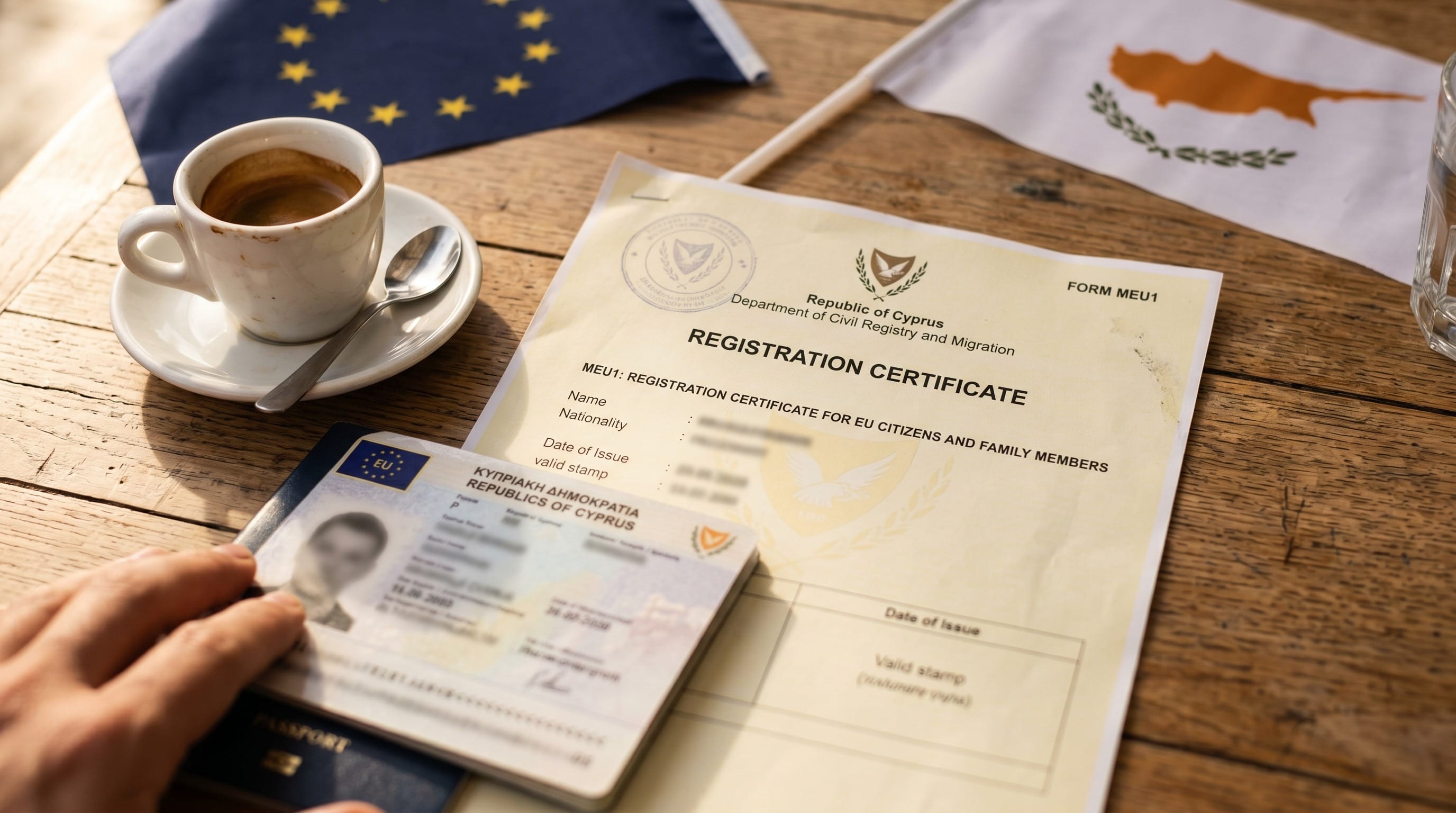
An EHIC and an S1 are the two documents EU citizens most often expect to settle the health question on the Yellow Slip, the MEU1 registration certificate EU, EEA and Swiss citizens obtain for stays over 3 months under Law 7(I)/2007. The Migration Department's document list treats both narrowly: one appears in a single category, the other a pensioner route.
The broader question of which EU citizens need health insurance for the Yellow Slip is answered on its own page, category by category. This page takes the two documents people arrive holding and checks each one against the list.
Everything below comes from the checklist the Migration Department publishes with the MEU1 form, read in both of its language versions, and from the EU's own guidance for citizens living abroad. Our full guide to the MEU1 and the Yellow Slip sets the same material alongside the fees, the 4-month deadline and the appointment itself.
Is an EHIC Enough for the Cyprus Yellow Slip?
An EHIC is the European Health Insurance Card, which covers state-provided treatment during a temporary stay in another EU country. The card's own page sits under Your Europe's unplanned healthcare and temporary stays branch, and it states plainly that the EHIC "will not help you with rescue and repatriation", which is what the Cyprus checklist calls body transport costs. The EU's guidance for citizens living abroad still offers the card to non-employed students, and that is the one category Cyprus accepts it in. The EU guidance and the Cyprus checklist point the same way, which is worth knowing before you argue the card at a counter.
The card is accepted in 1 of the 6 applicant categories on the checklist, which is why applicants in the other five report having it turned down.
Is an S1 Form Enough for the Yellow Slip?
The route runs through the Ministry of Health, the department the checklist names for the E121 or S1. That distinction matters, because an S1 is not a GeSY registration in itself. The Health Insurance Organisation's beneficiary categories reach EU citizens through working in the areas controlled by the Republic of Cyprus, through holding a permanent residence permit, or as the dependant of someone who qualifies. Holding an S1 is not one of the listed routes, so treat the S1 and a GeSY registration certificate as two separate documents. Who actually holds an S1 is narrower than most guides suggest:
- Pensioners. The S1, formerly the E106, is requested from the health insurance institution in the country that pays the pension, then registered on arrival.
- Posted workers. Someone moving to the country they are posted to is offered the S1 as an alternative to the EHIC, not as a replacement for it.
- Cross-border workers on form A1. The MEU1 checklist asks this cohort for form A1 alongside cover for inpatient, outpatient and body transport costs, with no GeSY alternative offered in that line.
The first two come from Your Europe, which tells pensioners to request the S1 from the institution that pays the pension and, for a posting, says to apply "for the EHIC card, or, if you are moving to the country you are posted to, for an S1 form". The third comes from the Cyprus checklist itself.
What Do You Show If You Have Neither?
Two numbers travel with whichever document you bring. Registration on form MEU1 costs €20 per applicant, and Law 7(I)/2007 gives EU citizens 4 months from arrival to file, on a stay that passes 3 months. The Migration Department publishes the fee and the form on its MEU1 registration page. Neither number changes with the health document you choose.
What the MEU1 checklist does with each document
| Document you hold | Accepted for the MEU1? | What the checklist asks for alongside it |
|---|---|---|
| European Hospitalization Card (EHIC) | In the student category only | Nothing further in that row. In the other 5 categories the card is not listed at all |
| E121 or S1 form | In the pensioner routes, processed through the Ministry of Health | Named for pensioners under dependent direct ascendant and under visitor or visiting pensioner. It is not a GeSY registration in itself |
| GeSY registration certificate | Yes, in every category that offers the route | This is where the two official versions disagree: the English checklist adds body transport costs, the Greek original ends the line at the certificate |
| Social Insurance registration and contributions statement | Yes, for employed and self-employed applicants | Employed: a contributions statement naming the last employer and salary. Self-employed: a certificate of contributions for the last 4 months |
| A private policy | Yes, in every category that asks for cover | In-patient care, out-patient care and body transport costs, the same three in every line that asks for a policy |
Source: the Migration Department's MEU1 supporting-documents checklist on gov.cy, posted 29 December 2025 and read on 9 September 2026. Both language versions of that edition were read. The checklist publishes 6 category sheets, and the employed sheet covers four situations, which our fuller table renders as 8 separate lines.
So the order to work in is short. Check which of the 6 categories you fall under, look for a document you already hold in the rows above, and buy cover only when none of them fits. One naming point: the lower-case "(plan A)" on the checklist is its own shorthand for that cover, not the Plan A product we arrange for non-EU applicants on the Pink Slip path. Our guide to yellow slip and pink slip health insurance sets out which document each route needs. Where a policy is the answer for your category, ours is from €120 a year.
Bottom Line
An EHIC settles the health question on a Cyprus Yellow Slip application in one category, the student one. In the other five it is not on the Migration Department's list, and applicants who arrive holding only a card are asked for something else. EU guidance points the same way, since it is non-employed students abroad who are told to consider the card.
An E121 or S1 is the route the checklist names for pensioners, processed through the Ministry of Health. It is not a GeSY registration in itself: the Health Insurance Organisation lists the ways an EU citizen becomes a beneficiary, and holding an S1 is not one of them.
If you hold neither document, DigiCare Insurance, a licensed Cyprus insurance agency holding ICCS licence 2451, places cover carrying in-patient care, out-patient care and body transport costs from €120 a year. If a GeSY certificate is the evidence you will use instead, our guide to registering for GeSY in Cyprus sets out how to enrol, and check with your district office whether repatriation cover is asked for alongside it, because the two versions of the checklist disagree on that.
Other Questions About the EHIC and the S1 Form
Neither document in your file? See our Cyprus Yellow Slip insurance for a policy carrying in-patient, out-patient and body transport costs, from €120 a year.
Get a personalised car insurance quote in 60 seconds
Compare prices from 10+ Cyprus insurers without giving your phone number.
Get a Free QuoteMore Immigration Insurance FAQ
What does Plan A immigration insurance cover in Cyprus?
Plan A is the immigration medical policy required for Cyprus residence permits. It covers at least €13,700 of inpatient hospital treatment a year, plus repatriation of remains. It does not cover GP visits, maternity, chronic care, or pre-existing conditions.
Read the full answerWhat insurance do I need for a Cyprus residence permit?
Non-EU applicants for most Cyprus residence permits (Pink Slip, Permanent Residence, work or study) need Plan A immigration medical cover. Travel, home, and car insurance are separate from the permit. EU citizens on a Yellow Slip use GESY instead.
Read the full answerHow much does immigration insurance cost in Cyprus?
Plan A immigration insurance is priced by age and family size: from €120 per person per year, from €270 for retired applicants aged 70+, and from €420 or €560 for a family bundle. Every licensed Cyprus insurer writes the same cover headings, so the premium is what moves most; the caps behind them differ a little.
Read the full answerWhat is the best immigration insurance in Cyprus?
There is no single best Plan A insurance because every licensed Cyprus insurer writes the same cover headings. The caps and any deductible still differ, so read the schedule, then judge the provider: fastest stamped certificate, cleanest online checkout, and a price that matches the standard age band.
Read the full answerWhat health insurance do I need for an MCYV / MEU2 application in Cyprus?
The Cyprus Migration Department accepts either Plan A immigration insurance or a Certificate of Registration with the GHS (with body transport cover) for an MEU2 residence card application by a non-EU family member of an EU citizen. Plan A starts from €120 per year and is the most commonly used option.
Read the full answerWhat is the cheapest immigration medical insurance in Cyprus?
The cheapest is a standard Plan A policy, from €120 a year, with family bundles from €420. The cover shape is the same everywhere, so price is a fair first filter, but check the caps and any excess before you buy.
Read the full answerCover for your MEU1 file
If neither an EHIC nor an S1 fits your category, we issue in-patient, out-patient and body-transport cover from €120 a year.
Get a Free QuoteRelated Reading
MEU1 / Yellow Slip Cyprus: The Complete 2026 Guide for EU Citizens
14 May 2026

Yellow Slip and Pink Slip Health Insurance in Cyprus: The 2026 Complete Guide
6 April 2026

GeSY Cyprus: The Complete 2026 Guide to the General Healthcare System
7 April 2026